
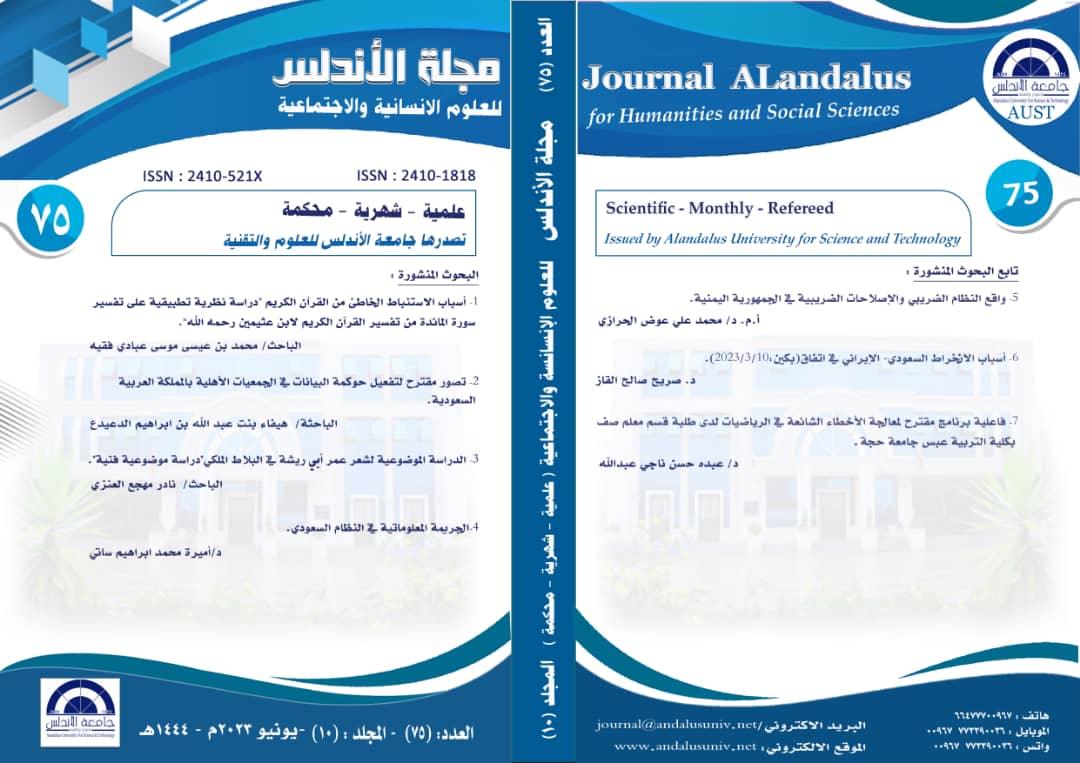
The Reality of the Tax System and Tax Reforms in the Republic of Yemen
Article Sidebar
Main Article Content
Abstract
The efficiency of the developed tax system is one of the most important manifestations of political stability and economic prosperity of countries. Therefore, countries work hard to ensure that their tax systems are modern and meet the demands of their economy, and take into account the nature and conditions of their societies. The tax system of the Republic of Yemen is no exception to the above, since this study aims to identify the components of the tax system in Yemen whose ancient civilizations Maeen, Qataban, Saba, Hadramout and Himyar knew many tax systems, as well that the tax systems it adopted under the Islamic states that successively ruled it or during the Ottoman or British occupation, or under the reign of the Imamate, or after the revolutions of September 1962 AD and October 1963 AD, as well as after the re-realization of Yemeni unity in 1990 AD, which can be said to have represented the most important stage in the chain of establishment and development of the Yemeni tax system , during which she witnessed the development and accompanied many tax systems in other countries. This study, which was prepared using a descriptive and analytical approach, deals with the most important concepts of the tax system, its characteristics and the reality of the tax system in the Republic of Yemen. The study concluded with several findings, the most important of which is the relationship between the tax system and the development of the economic system in the country, the impact of repeated changes in tax laws in Yemen on the stability of the tax system in it, and the low percentage of tax contribution to the Yemeni GDP, which indicates the flaw in the tax system.