
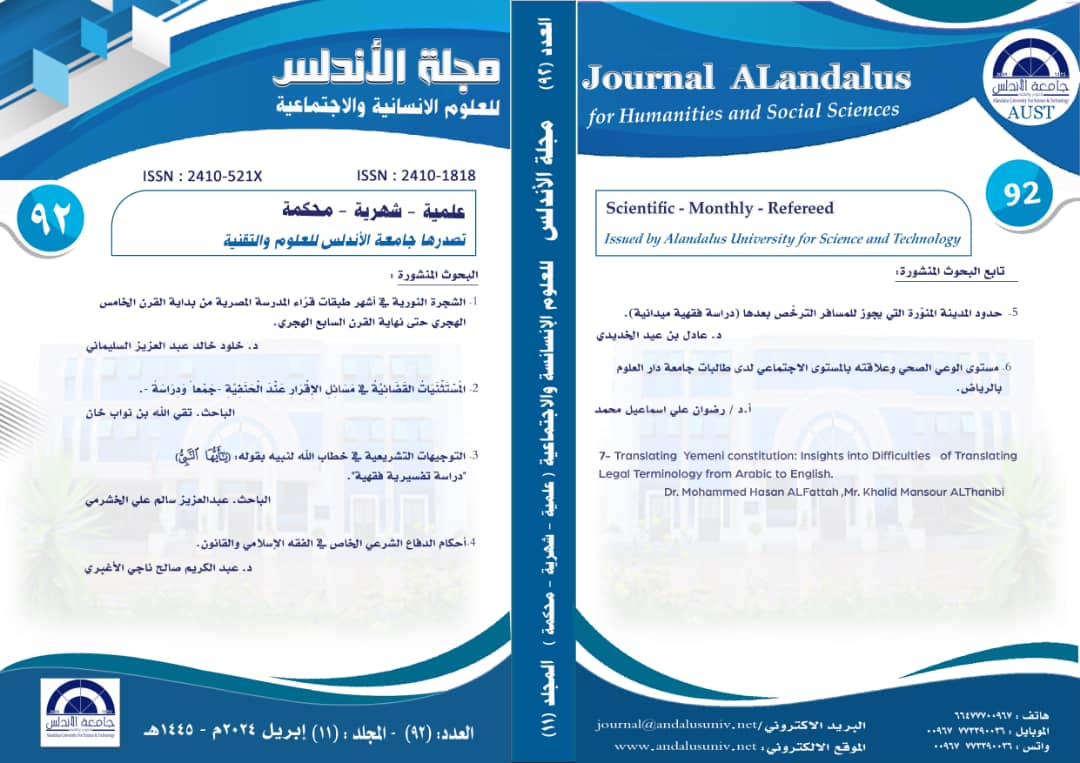
الشجرة النورية في أشهر طبقات قراء المدرسة المصرية من بداية القرن الخامس الهجري حتى نهاية القرن السابع الهجري
Article Sidebar
Main Article Content
Abstract
The aim of this research is to introduce the famous readers in Egypt from the beginning of the fifth century Hijri to the end of the seventh century Hijri, and to classify them into categories to assist those looking for biographies of prominent readers over different periods and regions. The research problem lies in the challenge of collecting biographical information about readers from biographical and categorization books, individually extracting readers of each region of Egypt, and then ordering them by time which would require a considerable amount of time and effort. Therefore, it was decided to present biographies of readers based on a specific time period and location, using biographical books of readers and their categories. The importance of the research lies in studying the categories of famous readers in Egypt, explaining their circumstances, biographies, and highlighting the distinct features of the recitation movement in Egypt. The research methodology follows a historical-inductive approach in arranging the biographies of readers, focusing on prominent readers of the Egyptian school from the beginning of the fifth century Hijri until the end of the seventh century Hijri, and attributing them to the regions they resided in, visited, taught in, or traveled to. The research is organized into an introduction and a preface that define categories, readers, reciters, and the school, divided into two chapters. The first chapter delves into the introduction of recitation in Egypt, its spread, its influence on and by other schools, prevalent narrations in Egypt since the Islamic era. The second chapter presents the categories of readers of the Egyptian school from the beginning of the fifth century Hijri to the end of the seventh century Hijri, and concludes with the scientific output of readers in Egypt during this period. The study closes with conclusions, such as the Egyptians' keenness on receiving and reciting the Quran since the advent of Islam in Egypt, the significant impact of prominent reciters like Warsh in establishing the Egyptian school, documenting its relationships with other schools, and the esteemed status of the Egyptian school due to its distinguished figures who devoted their lives to serving the Quran and its sciences. Finally, the research ends with recommendations, emphasizing the importance of scholars' interest in the science of readers' categories in various countries and across different eras. Furthermore, it recommends dedicating more studies and research to this field. The research includes an index of sources, references, and a subject index.