
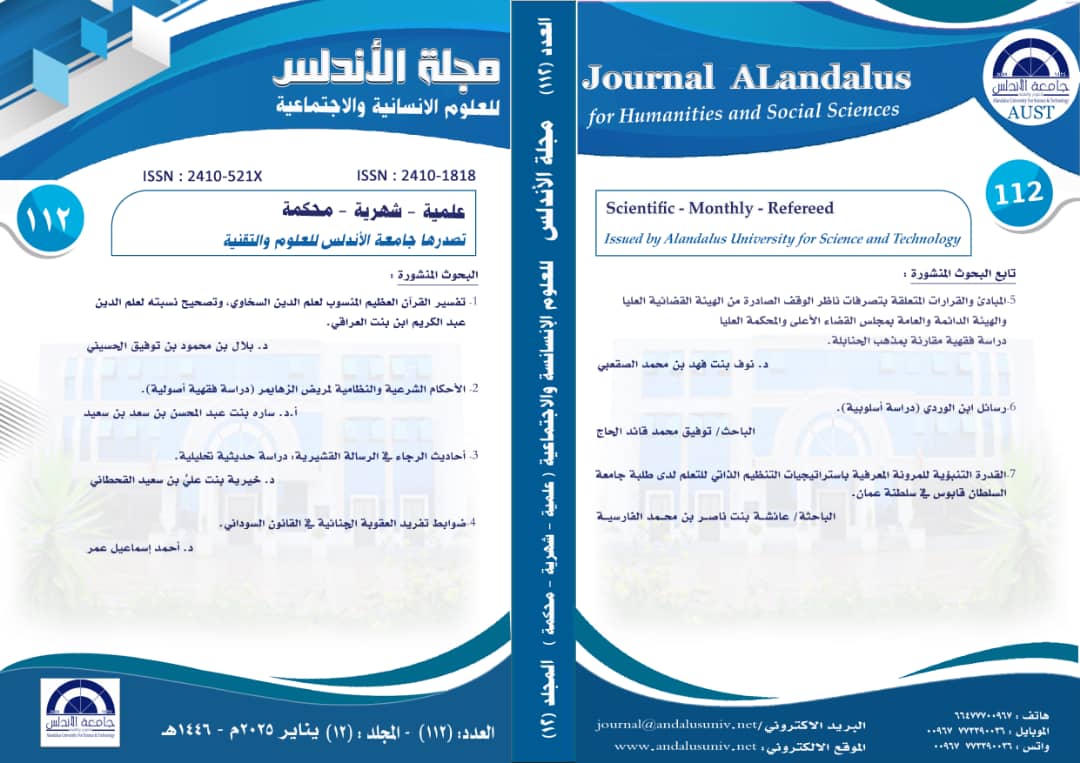
The Principles and Decisions Pertaining to the Actions of the Overseer of the Waqf "the Endowment" Issued by the Supreme Judicial Authority, the Permanent and General Committees of the Supreme Judicial Council and the Supreme Court: A Comparative Jurispru
Article Sidebar
Main Article Content
Abstract
Objectives of the Research: -To compile the judicial principles related to the overseer of the waqf (the endowment) as issued by the Supreme Judicial Authority, the Permanent and General Committees of the Supreme Judicial Council, and the Supreme Court, along with their explanations and supporting evidence. -To elucidate the Hanbali perspective on these judicial principles, clarifying whether they align with or diverge from the established principles. -To propose a formulation for the judicial principle, if deemed necessary, accompanied by justifications for such a proposal. Research Methodology: Descriptive, inductive, and comparative approach This study aims to elucidate the judicial principles concerning the overseer of the waqf (the endowment) as issued by the Supreme Judicial Authority, the Permanent and General Committees of the Supreme Judicial Council, and the Supreme Court. These principles hold significant importance in the application of endowment rulings, serving as a reference for adjudicating matters related to endowments and resolving disputes that may arise between the overseers of the waqf (the endowment) and beneficiaries. Furthermore, they establish a fundamental framework for holding the overseer accountable in cases of transgression or negligence. Among the most significant findings of the researcher are: - The judicial principles align with the Hanbali viewpoint that the overseer must first adhere to the stipulations of the founder. In the absence of such stipulations or when they are unknown, the overseer should follow the established customary practices of previous overseers. - If the overseer is unaware of the founder's stipulations and does not understand the distribution of the endowment's revenue, they should consider the practices of their predecessors. If such knowledge is unattainable, they should then rely on prevailing customs. In the absence of established customs, they should act according to the prevailing norms in that context. Thus, the judicial principle is in agreement with the Hanbali school of thought.