
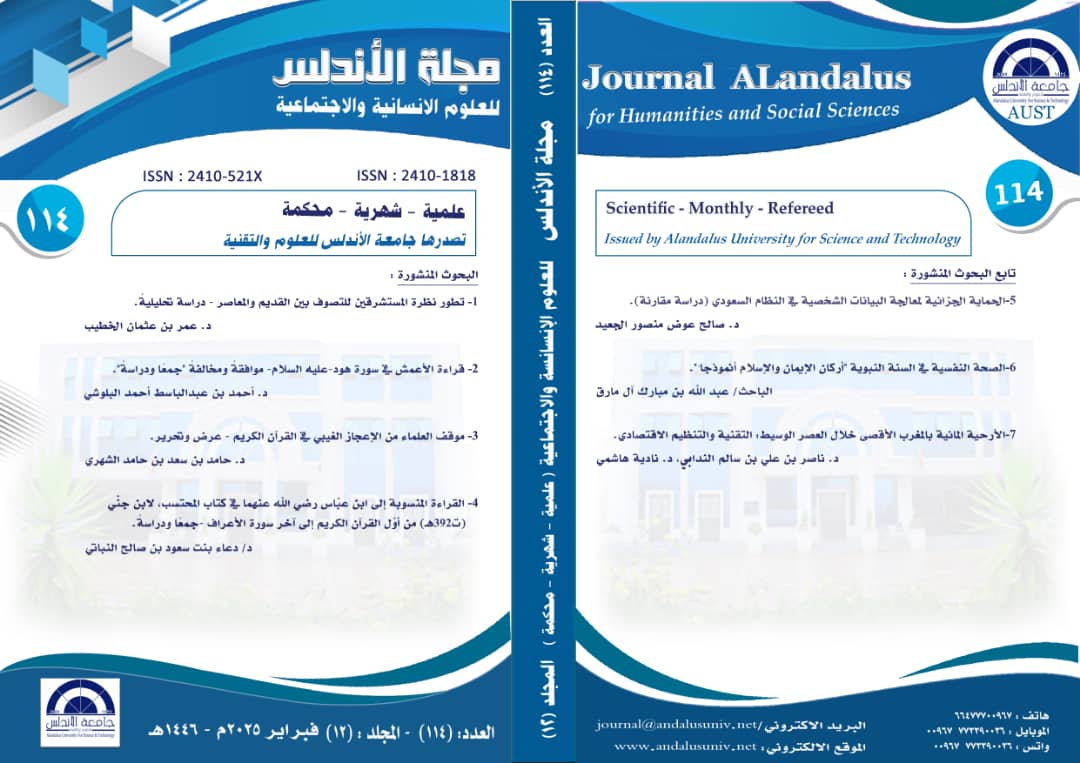
The Reading of Ibn Abbas, May Allah Be Pleased with them, in the Book "Al-Muhtasib" by Ibn Jinni "D. 392 AH." from the Beginning of the Quran to the End of Surah Al-A'raf: Compilation and Study 10.35781/1637-000-114-004
Article Sidebar
Main Article Content
Abstract
Since the various Quranic readings have been transmitted to us through the Companions, may Allah be pleased with them, and subsequently, linguists have made them a source for deriving grammatical, phonetic, morphological, and semantic rules from both the recited and non-recited aspects, this research examines the reading of the Companion Abdullah ibn Abbas, may Allah be pleased with them, from the beginning of the Quran to the end of Surah Al-A'raf. This is done through the book "Al-Muhtasib" by Ibn Jinni, which clarifies the aspects of irregular readings and explains them. The research aims to survey Ibn Abbas's reading, study it, and highlight Ibn Jinni's attention in directing and using it as evidence, following the inductive, descriptive, and analytical methods. I have compiled the reading instances as mentioned in the order of the book "Al-Muhtasib," then presented the text that Ibn Jinni used to direct the mentioned reading, followed by a study and conclusion to highlight the specific result of each reading, and explain its diverse implications in direction and evidence. Key Findings: •The readings of Ibn Abbas covered in the study differ from the ten widely transmitted readings, except for the reading of "Azar" [Al-An'am: 74] with the nominative case, which aligns with the reading of Ya'qub. •Ibn Jinni's methodology in directing Ibn Abbas's readings varied: sometimes using the Quranic verse, other times the reading of the group, or the speech of the Arabs, or lexical usage. •The number of unique readings of Ibn Abbas within this study is thirteen, while the remaining readings are attributed to him and other Companions and Followers.