
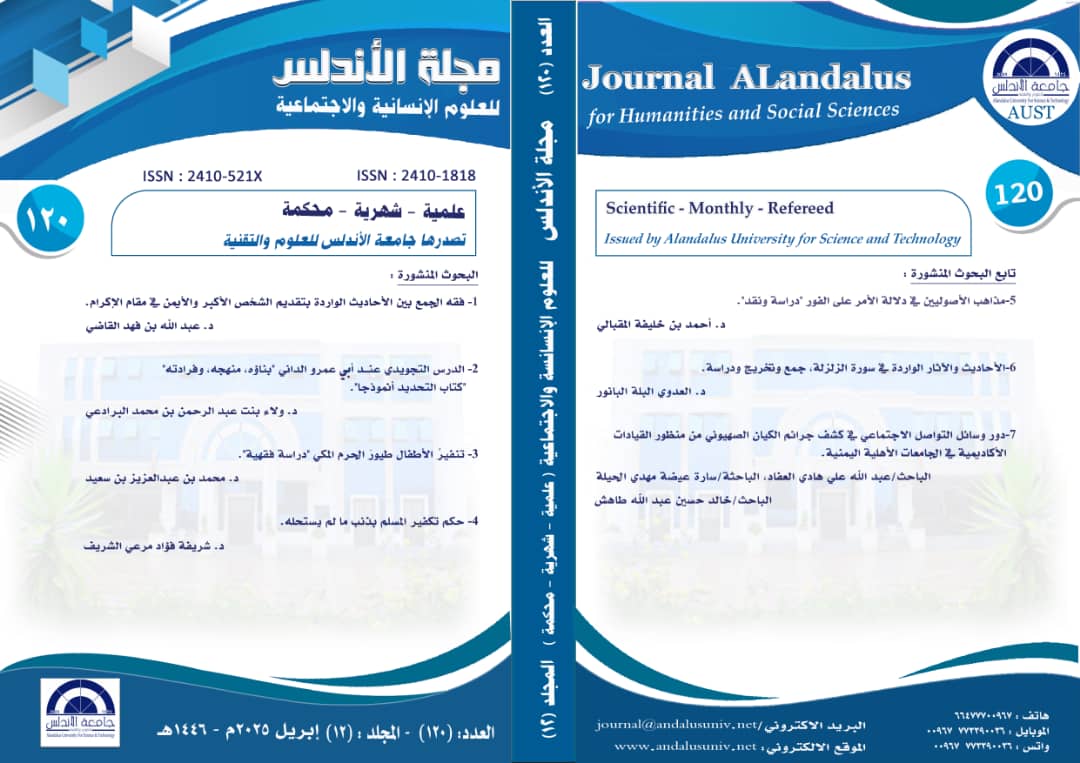
The Ruling on Proclaiming a Muslim to be a Disbeliever Due to a Sin not Deem Permissible 10.35781/1637-000-120-004
Article Sidebar
Main Article Content
Abstract
This research aims to clarify the ruling on declaring a Muslim to be a disbeliever due to a sin s/he does not deem permissible. The research adopts a descriptive, analytical, and critical approach. It includes three sections: the definition of the research terminology, the ruling on declaring a Muslim to be a disbeliever due to a sin s/he does not deem permissible, and the declaration of a Muslim to be a disbeliever due to sin according to opposing sects and the response to them. The research has been concluded with several findings, the most vital of which are: • Apostasy is a grave matter, with severe consequences, both in this life and in the hereafter. • There are two types of apostasy mentioned in Quran and Sunnah: greater and lesser. The greater apostasy expels a person from the fold of Islam while the lesser one does not expel the person from Islam but negates the obligatory perfection.- The Sunnis (Ahl Al-Sunnah) do not declare a Muslim if s/he is caught in the act of disbelief or falls into a contradiction of one of the nullifiers of Islam, unless s/he deems it impossible to be believed. • In Islamic law, deeming something lawful that is actually prohibited is considered apostasy. It is of two types: Istihlal of the hearty and Istihlal of the action. The heartfelt Istihlal is deemed to be disbelief by consensus of the Muslims scholars whereas the action Istihlal is deemed to be a grave sin that necessitates repentance. • Sunnis (Ahl Al-Sunnah) differ with Khawarij, who declare apostasy for every sin and Mu'tazila, as well as the Rafidah, who declare apostasy without any Islamic evidence.