
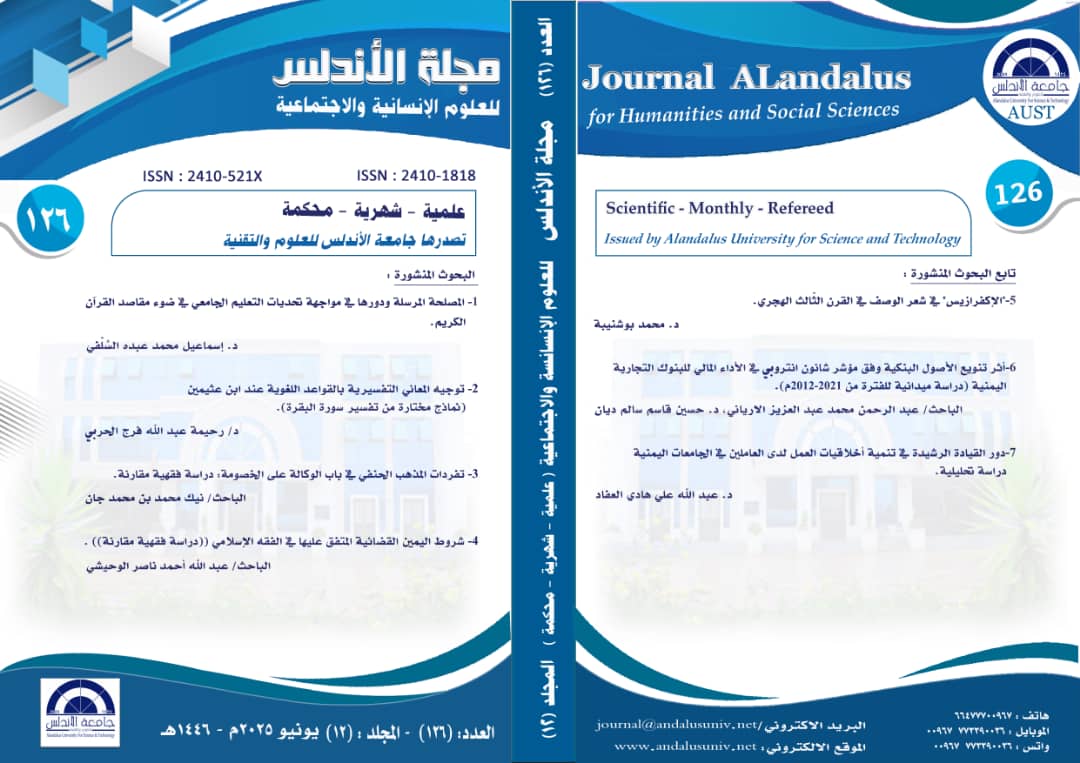
Directing Interpretive Meanings with Linguistic Rules According to Ibn Uthaymeen: Selected Models from the Interpretation of Surat Al-Baqarah 10.35781/1637-000-126-002
Article Sidebar
Main Article Content
Abstract
This research aims to examine the linguistic principles employed by Ibn ʿUthaymīn in directing the meanings of the Qur’anic text, clarifying his methodological approach, and highlighting the benefits of interpreting Qur’anic meanings through linguistic rules. The study focuses on the most prominent linguistic principles he used, their classifications, and the challenges faced by some scholars who applied linguistic or legal principles in exegesis. To achieve this, the researcher adopted both descriptive and inductive methodologies, confining the study to Ibn ʿUthaymīn’s interpretation and selected examples from his commentary on Sūrat al-Baqarah, due to the vast scope of the subject, the multitude of principles involved, and the variance in their application. The study concludes that some linguistic principles can be considered foundational and comprehensive, while others are subsidiary. It also identifies inconsistencies in the application of certain rules in guiding interpretations— often resulting from issues in the formulation of the rules themselves or due to specific expressions deviating from the norm for various reasons. The researcher recommends further study of the general formulations of the linguistic principles employed in tafsīr, with an emphasis on refining their structure and limits, as well as examining the factors contributing to inconsistencies in their use.