
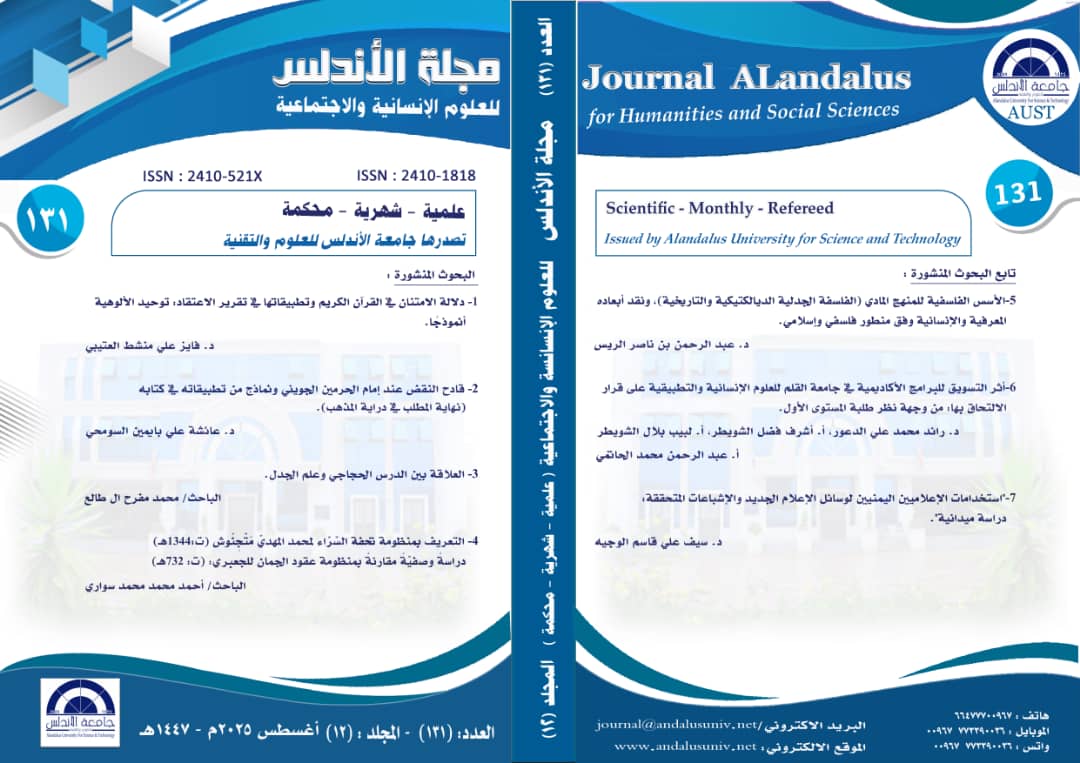
The Impact of Marketing Academic Programs at Al-Qalam University for Human and Applied Sciences on Students’ Enrollment Decision: A Perspective from First-Year Students 10.35781/1637-000-131-006
Article Sidebar
Main Article Content
Abstract
The current research aims to measure the reality of the academic marketing program at Al-Qalam University and its impact on enrollment from the perspective of first-year students. This is achieved by examining the current state of the academic marketing program in terms of direct marketing, public relations, advertising, and other supporting factors that contribute to attracting students. To achieve this objective, the descriptive analytical approach was adopted, as it is the most suitable method for studying the current research problem and is widely used in administrative sciences. A questionnaire was employed as the primary research tool to collect the necessary data. The research sample consisted of 149 individuals selected through a convenient sample from the research population, which included first-year students at Al-Qalam University for Humanities and Applied Sciences. The collected data were statistically processed and analyzed. The study found several key findings, most notably the marketing of academic programs at Al-Qalam University for Humanities and Applied Sciences, from the perspective of first-year students, achieved an overall mean of 3.88 out of 5, rated as high degree. It was also rated high degree across the dimensions of academic program marketing reality, direct marketing, public relations, advertising and publicity, and supporting factors in attracting students, with mean scores ranging between 3.62 and 4.15. The overall mean was 3.89, also rated as high, regarding students’ enrollment in the university’s programs, the existence of a statistically significant effect at the 0.05 significance level of academic program marketing on the enrollment status at Al-Qalam University for Humanities and Applied Sciences. The university’s academic reputation and geographical locations were also found to play a significant role in the enrollment process. The research concluded with a set of recommendations, the most prominent of which were organizing awareness sessions for students to introduce the university and its programs, as well as conducting field visits to secondary schools to provide information about the university’s programs and services.