
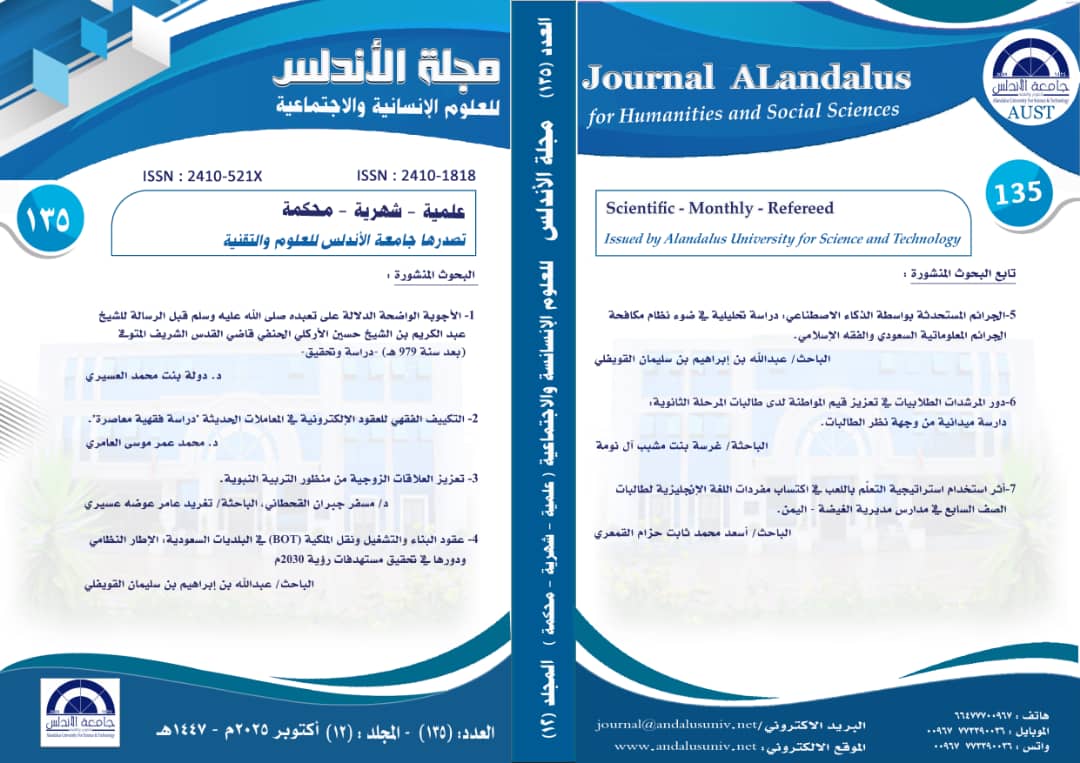
The Jurisprudential Adaptation of Electronic Contracts in Modern Transactions: A Contemporary Jurisprudential Study 10.35781/1637-000-135-002
Article Sidebar
Main Article Content
Abstract
This study, entitled "The Jurisprudential Adaptation of Electronic Contracts in Modern Transactions-A Contemporary Jurisprudential Study," aims to demonstrate the extent to which contracts concluded via electronic media are consistent with the provisions of Islamic jurisprudence. This is achieved by analyzing their pillars, conditions, and effects, and highlighting the legal controls that ensure their integrity. The study also seeks to develop a precise and disciplined jurisprudential conception that encompasses the technical characteristics of digital contracts and balances jurisprudential principles with the requirements of contemporary economic reality. This is achieved by examining the issues of consent, offer, acceptance, proof, and reliability in the electronic environment. This contributes to the development of jurisprudential ijtihad (reasoning) to keep pace with technological transformations. The study follows the descriptive- analytical method and the comparative method. The study concludes that electronic contracts can be legally adapted as valid contracts provided, they meet their legal pillars and are free of uncertainty and uncertainty. Furthermore, the expression of digital will be considered valid under Islamic law if there is conclusive evidence of consent. The research also demonstrated the flexibility of Islamic jurisprudence and its ability to accommodate technological developments without compromising its essence or objectives, emphasizing the need for collective ijtihad, specialized oversight bodies, and contemporary jurisprudential codes to regulate these contracts. Thus, the research strengthens trust and legitimacy in electronic transactions and establishes a jurisprudential foundation that ensures their compatibility with the objectives of Sharia and the requirements of the digital age.