
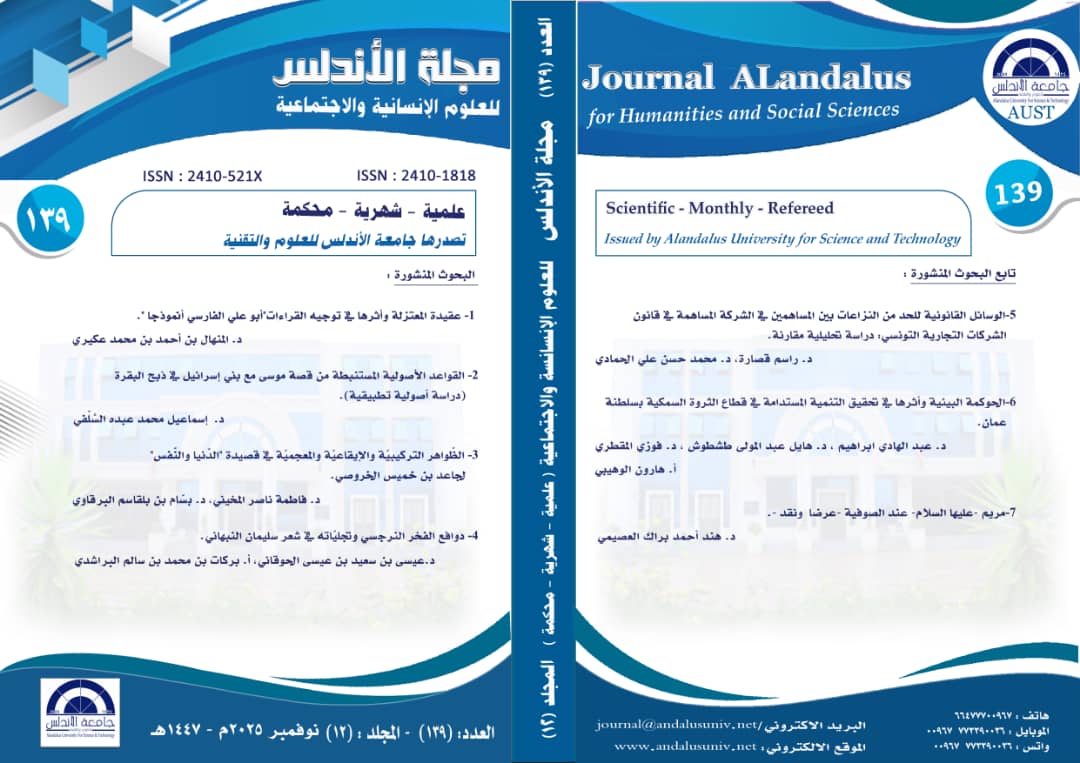
Environmental Governance and its Impact on Achieving Sustainable Development in the Fisheries Sector in the Sultanate of Oman 10.35781/1637-000-139-006
Article Sidebar
Main Article Content
Abstract
This study addresses the issue of environmental governance and its impact on achieving sustainable development in the fisheries sector in the Sultanate of Oman. The importance of the study emerges in light of the growing environmental challenges facing this vital sector, including the decline in fish stocks, overfishing, and marine pollution - all of which call for an effective governance framework to ensure the sustainability of marine resources. The study aimed to identify the extent to which the principles of environmental governance - namely policies and legislation, transparency, and accountability - are adopted within the sector, and to analyze their impact on achieving the economic and environmental dimensions of sustainable development. To achieve its objectives, the study employed the descriptive-analytical approach, and data were collected through a questionnaire distributed to a sample of 352 participants working in institutions and entities related to the fisheries sector. The results showed that the level of adoption of environmental governance in the sector ranges from moderate to low. The findings also revealed a statistically significant impact of applying environmental governance principles on enhancing economic development and environmental protection. The study recommended the need to develop environmental policies and legislation, strengthen transparency and accountability mechanisms, and activate institutional oversight in line with sustainability requirements and the objectives of Oman Vision 2040.