
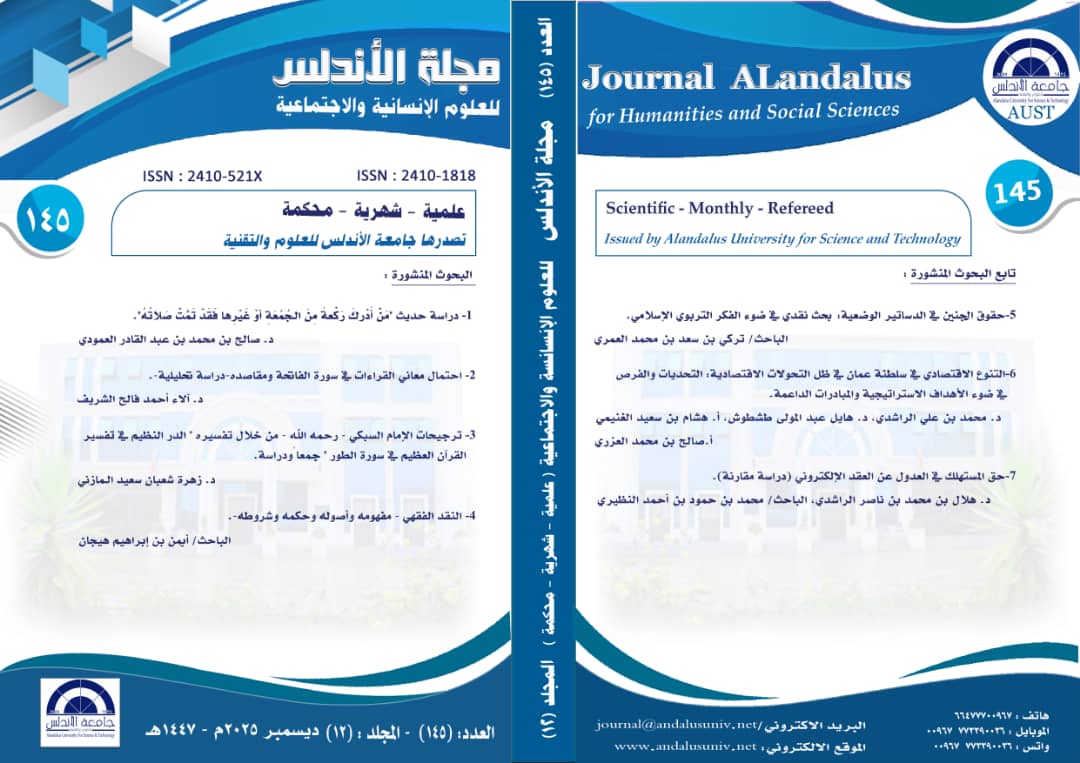
Imam Al-Subki Preferences in his Tafsir "Al-Durr Al-Nazim fi Tafsir Al-Qur'an Al-Azim" in Surah Al-Tur: Compilation and Study 10.35781/1637-000-145-003
Article Sidebar
Published:
Feb 21, 2026
Keywords:
ترجيحات | السبكي | الدر النظيم | الطور | Juristic Preferences | Alsubkī | Al-Durr Al-Naẓīm | Sūrat Al-Ṭūr
Main Article Content
Abstract
Abstract This study aims to examine the juristic preferences (tarjīḥāt) of Imam al-Subkī in his Qurʾanic exegesis al-Durr al-Naẓīm fī Tafsīr al-Qurʾān al-ʿAẓīm, with a particular focus on Sūrat al-Ṭūr. The research adopts an inductive–analytical methodology and is structured into an introduction and three chapters: the first introduces the author and his work; the second elucidates al-Subkī’s methodology in preferring one opinion over others; and the third presents an applied study of his juristic preferences through his interpretation of Sūrat al-Ṭūr. The study arrives at several key findings, most notably that al-Subkī, when favoring a particular opinion, explicitly employs clear expressions of preference, or, at times, merely expresses approval of a given view. When weakening an opinion, he generally uses explicit terms indicating such weakening. The majority of his preferences are consistent with the views of the majority of Qurʾanic exegetes. The research examines five specific instances: first, al-Subkī’s preference that the “inscribed Book” refers to the records of good and bad deeds; second, that the “raised ceiling” denotes the sky; third, that the term faith in the verse “And those whose offspring followed them in faith” refers to the faith of the parents; fourth, his preference that the Day of the Swoon refers to both the Day of the Trumpet Blast and the Day of Resurrection due to their close association; and fifth, his preference that the phrase “at the retreat of the stars” refers to the two rakʿahs performed before the Fajr prayer. Keywords: Juristic Preferences; al-Subkī; al-Durr al-Naẓīm; Sūrat al-Ṭūr.
Article Details
Issue
Section
المقالات