
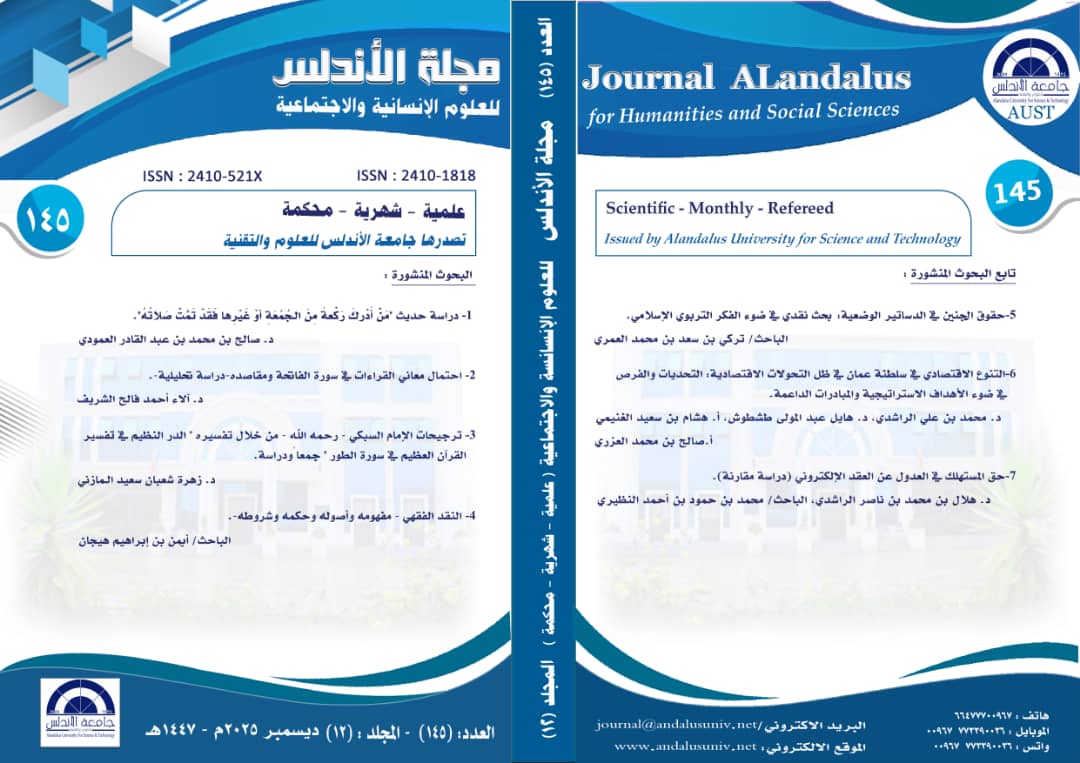
The Consumer’s Right of Withdrawal from Electronic Contracts: A Comparative Study 10.35781/1637-000-145-007
Article Sidebar
Published:
Feb 21, 2026
Keywords:
العقد الإلكتروني | حق العدول | المستهلك الإلكتروني | المزود | Electronic Contract | Right of Withdrawal | Electronic Consumer | Supplier
Main Article Content
Abstract
Legislators have long sought to provide consumer protection in traditional contracts through various legal mechanisms. However, with the rapid development of technology, new types of contracts have emerged that rely on electronic means for their formation. This development has rendered traditional protective mechanisms insufficient to ensure adequate consumer protection. Accordingly, a key question arises as to whether the consumer should be granted the right to withdraw from an electronic contract, and what the position of Omani law is regarding the recognition of this right in comparison with other legal systems. This research aims to examine the stance of the Omani legislator on recognizing the consumer’s right of withdrawal from electronic contracts, as well as the regulations governing its exercise and its legal effects. The study also provides a comparative analysis between Omani law and the laws of Egypt, Saudi Arabia, and Qatar. The research is structured into two chapters: the first addresses the concept of the consumer’s right of withdrawal from electronic contracts and its legal nature, while the second examines the scope of application of this right, the conditions governing its exercise, and its legal effects. The study adopts an analytical methodology through the analysis of relevant legal texts, in addition to a comparative approach by comparing Omani law with Egyptian, Saudi, and Qatari laws. The research concludes that Omani legislation does not expressly provide for the consumer’s right of withdrawal from electronic contracts, whereas this right is recognized under Egyptian, Saudi, and Qatari legislation. The study recommends that the Omani legislator intervene to regulate this right in order to ensure effective protection for electronic consumers.
Article Details
Issue
Section
المقالات