
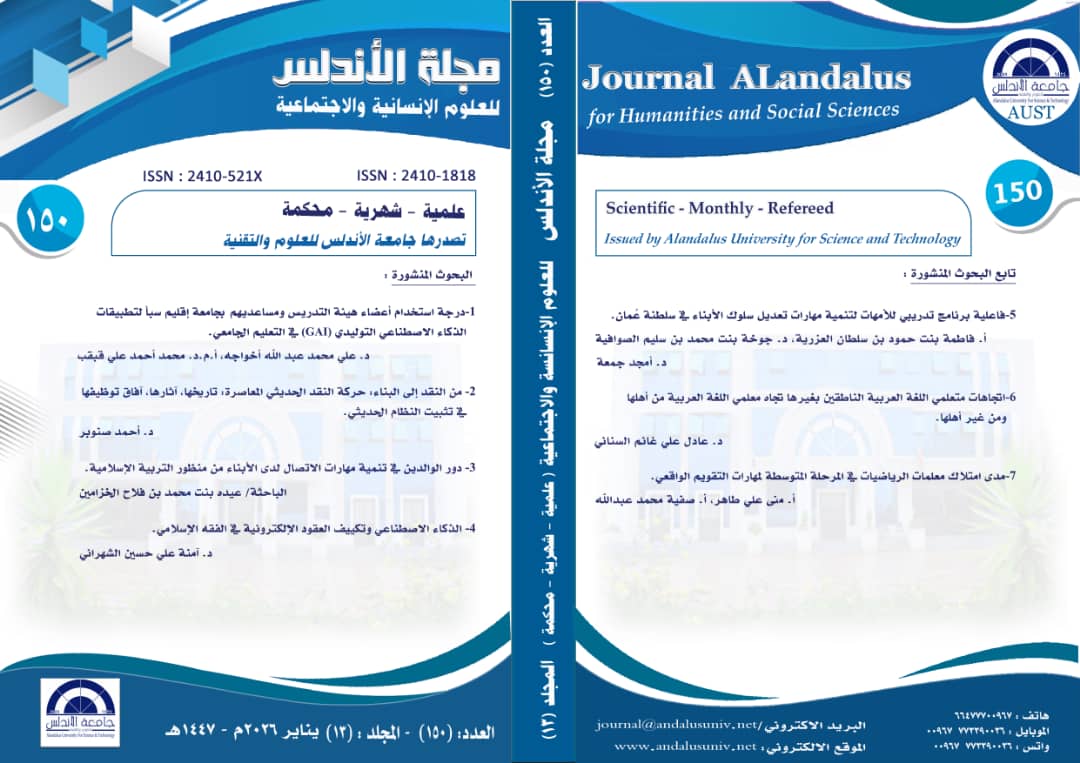
Form Critique to Construction: The Contemporary Hadith Criticism Movement: Its History, Impacts and the Prospects for its Methodological Employment in Consolidating the Hadith System 10.35781/1637-000-150-002
Article Sidebar
Published:
Feb 21, 2026
Keywords:
النقد الحديثي | علم العلل | ظاهر الإسناد | الألباني | النظام الحديثي | المتقدمون | Hadith Criticism | The Science of ʿilal | Apparent Isnād-Based Criticism | Alalbānī | The Hadith System | Early Critics
Main Article Content
Abstract
Abstract This study seeks to trace the historical development of the contemporary hadith criticism movement and to analyze the epistemological and methodological factors that contributed to its formation, while also examining its positive and negative scholarly impacts. Employing a comparative historical–analytical methodology, the study concludes that the dominance of isnād-based criticism grounded primarily in the apparent structure of the chain of transmission during a particular phase—together with the expansion of takhrīj practices and judgments on chains—paved the way for the emergence of another critical trajectory that accords greater attention to circumstantial evidence (qarāʾin) and hidden defects (ʿilal). This shift is understood as a natural development resulting from the intensification of critical practice, broader engagement with the applied methods of the early critics, and the increasing availability of works on ʿilal. This transformation contributed to the revival of the science of ʿilal, a deeper understanding of the methodology of the early critics, and the emergence of multiple research trajectories. However, the study also identifies certain practices that require methodological restraint, such as the depreciation of the contributions of later scholars or the excessive weakening of well-established hadiths under the claim of applying the methodology of the early critics without adequately accounting for their modes of authentication. In its conclusion, the study emphasizes the importance of directing contemporary scholarly efforts toward highlighting the coherent epistemological structure of hadith studies and proposes constructive research trajectories, including comparative studies in the epistemology of testimony and investigations in the sociology of isnād networks. Such approaches, the study argues, can contribute to the rediscovery of the hadith system and to demonstrating its strength and internal coherence within the context of the contemporary human sciences. Keywords: Hadith criticism; the science of ʿilal; apparent isnād-based criticism; al-Albānī; the hadith system; early critics.
Article Details
Issue
Section
المقالات