
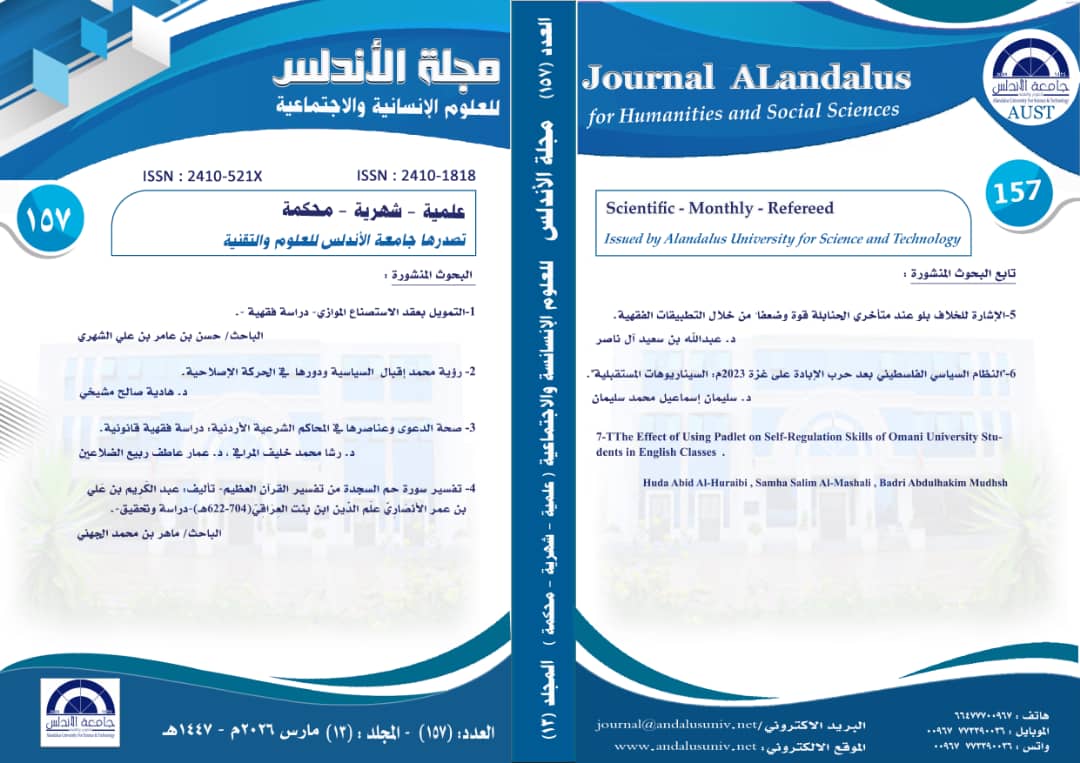
The Political Vision of Muhammad Iqbal and Its Role in the Reform Movement 10.35781/1637-000-157-002
Article Sidebar
Published:
May 11, 2026
Keywords:
محمد إقبال | الجامعة الإسلامية | التيار الإسلامي الإصلاحي | الهند | الباكستان | Muhammad Iqbal | Pan-Islamism | Islamic Reformist Movement | India | Pakistan
Main Article Content
Abstract
Abstract
Abstract: This study aims to explore the features of the reformist thought of Muhammad Iqbal, a distinguished intellectual who combined poetry, politics, philosophy, and reformist concerns within a unified vision. He offered a unique reading of the condition of Muslims, a particular conception of the modernization project, and a political vision that guided his thought and shaped his positions toward the intellectual currents of his time. The study adopts a descriptive-analytical methodology, which has enabled us to present Iqbal’s ideas, examine the arguments he put forward, and analyze his positions. The research has led to the following findings: The significance of Muhammad Iqbal’s reformist project lies in its emphasis on the necessity of renewing religious thought, which he referred to as the “principle of movement in Islam,” as well as in his contribution to enriching Arab and Islamic thought at the beginning of the twentieth century. His positions toward the political intellectual currents that emerged in the Ottoman Empire—from the reign of Abdul Hamid to the fall of the Ottoman state—were marked by both diversity and critical engagement. Moreover, his ethical and political commitment made him a clear example of an engaged intellectual, as reflected in his steadfast support for the idea of Pan-Islamism, which he advocated throughout his life. Keywords: Muhammad Iqbal – Pan-Islamism – Islamic Reformist Movement – India – Pakistan.
Abstract: This study aims to explore the features of the reformist thought of Muhammad Iqbal, a distinguished intellectual who combined poetry, politics, philosophy, and reformist concerns within a unified vision. He offered a unique reading of the condition of Muslims, a particular conception of the modernization project, and a political vision that guided his thought and shaped his positions toward the intellectual currents of his time. The study adopts a descriptive-analytical methodology, which has enabled us to present Iqbal’s ideas, examine the arguments he put forward, and analyze his positions. The research has led to the following findings: The significance of Muhammad Iqbal’s reformist project lies in its emphasis on the necessity of renewing religious thought, which he referred to as the “principle of movement in Islam,” as well as in his contribution to enriching Arab and Islamic thought at the beginning of the twentieth century. His positions toward the political intellectual currents that emerged in the Ottoman Empire—from the reign of Abdul Hamid to the fall of the Ottoman state—were marked by both diversity and critical engagement. Moreover, his ethical and political commitment made him a clear example of an engaged intellectual, as reflected in his steadfast support for the idea of Pan-Islamism, which he advocated throughout his life. Keywords: Muhammad Iqbal – Pan-Islamism – Islamic Reformist Movement – India – Pakistan.
Article Details
Issue
Section
المقالات