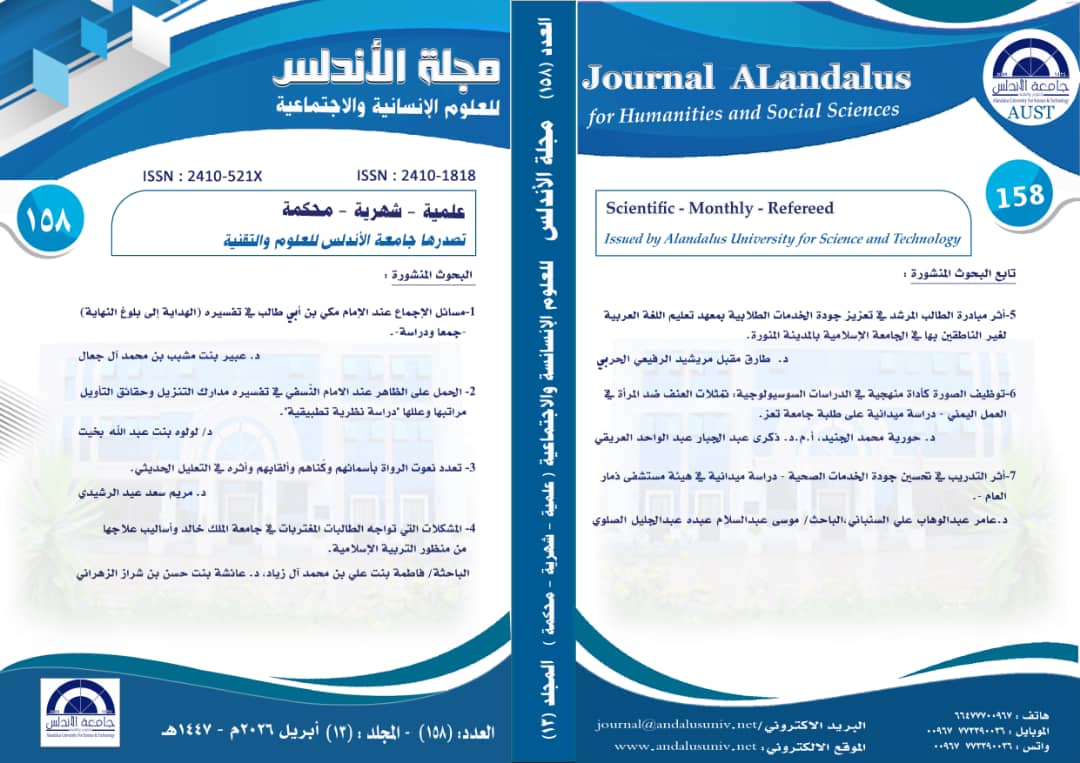
Adopting the Apparent Meaning "Al-Hamal Ala Al-Zahir" According to Lmam Al-Nasafl in His Tafsir Madarik Al-Tanzil Wa Haqaiq Al Tawill: Its Ranks and Rationale: A Theoretical and Applied Study 10.35781/1637-000-158-002
Article Sidebar
Published:
May 11, 2026
Keywords:
الظاهر | العلل | المراتب | الحمل | Apparent Meaning | Causes
Main Article Content
Abstract
Abstract
Abstract: This research examines the principle of interpreting the Qur’anic text according to its apparent meaning in the exegesis of Abu al-Barakat al-Nasafi, through a theoretical and applied study within the field of Qur’anic Exegesis (Tafsir). The importance of this topic lies in clarifying the role of exegetical principles in regulating the understanding of the Qur’anic text and highlighting the methodology of Qur’anic commentators in dealing with the semantic indications of Qur’anic expressions. In particular, the principle of adhering to the apparent meaning is considered one of the most important controls that safeguard the Qur’anic meaning from deviation. The study also analyzes the linguistic forms of the expressions and the levels of their semantic indications, and compares al-Nasafi’s approach with the methodologies of other Qur’anic exegetes. The research aims to clarify the concept of the principle of acting upon the apparent meaning, to reveal the methodology of Imam al-Nasafi in employing this principle in his Qur’anic commentary, and to identify its forms and applications in the interpretation of Qur’anic verses. It also seeks to enrich Qur’anic studies by addressing a perspective that has not previously received sufficient scholarly attention. The researcher adopts several methodological approaches, including the inductive method, the analytical-deductive method, and the descriptive method. The research plan consists of an introduction, a preliminary section, and two main chapters. The introduction discusses the significance of the topic, the reasons for selecting it, the research questions, objectives, previous studies, and the methodology adopted in the study. The preliminary section presents a brief biography of Imam al-Nasafi, including his name, lineage, upbringing, teachers, scholarly works, and his general methodology in Qur’anic exegesis. The first chapter discusses the definition of the principle of acting upon the apparent meaning, the evidences supporting it, and the extent to which scholars have relied upon this principle in interpreting the Qur’an. The second chapter Its forms, the reasons that necessitate them, the justified departure from the apparent meaning, and an analytical study of applied examples from his exegesis. Among the most important findings of the research is that the principle of interpreting according to the apparent meaning represents one of the fundamental rules in Qur’anic exegesis, and that Imam al-Nasafi tends to interpret Qur’anic verses in accordance with their apparent meaning within the context of the verse unless there is evidence that diverts the meaning from its apparent sense. Keywords: Apparent Meaning – Causes (‘Ilal) – Text – al-Nasafi.
Abstract: This research examines the principle of interpreting the Qur’anic text according to its apparent meaning in the exegesis of Abu al-Barakat al-Nasafi, through a theoretical and applied study within the field of Qur’anic Exegesis (Tafsir). The importance of this topic lies in clarifying the role of exegetical principles in regulating the understanding of the Qur’anic text and highlighting the methodology of Qur’anic commentators in dealing with the semantic indications of Qur’anic expressions. In particular, the principle of adhering to the apparent meaning is considered one of the most important controls that safeguard the Qur’anic meaning from deviation. The study also analyzes the linguistic forms of the expressions and the levels of their semantic indications, and compares al-Nasafi’s approach with the methodologies of other Qur’anic exegetes. The research aims to clarify the concept of the principle of acting upon the apparent meaning, to reveal the methodology of Imam al-Nasafi in employing this principle in his Qur’anic commentary, and to identify its forms and applications in the interpretation of Qur’anic verses. It also seeks to enrich Qur’anic studies by addressing a perspective that has not previously received sufficient scholarly attention. The researcher adopts several methodological approaches, including the inductive method, the analytical-deductive method, and the descriptive method. The research plan consists of an introduction, a preliminary section, and two main chapters. The introduction discusses the significance of the topic, the reasons for selecting it, the research questions, objectives, previous studies, and the methodology adopted in the study. The preliminary section presents a brief biography of Imam al-Nasafi, including his name, lineage, upbringing, teachers, scholarly works, and his general methodology in Qur’anic exegesis. The first chapter discusses the definition of the principle of acting upon the apparent meaning, the evidences supporting it, and the extent to which scholars have relied upon this principle in interpreting the Qur’an. The second chapter Its forms, the reasons that necessitate them, the justified departure from the apparent meaning, and an analytical study of applied examples from his exegesis. Among the most important findings of the research is that the principle of interpreting according to the apparent meaning represents one of the fundamental rules in Qur’anic exegesis, and that Imam al-Nasafi tends to interpret Qur’anic verses in accordance with their apparent meaning within the context of the verse unless there is evidence that diverts the meaning from its apparent sense. Keywords: Apparent Meaning – Causes (‘Ilal) – Text – al-Nasafi.
Article Details
Section
المقالات