
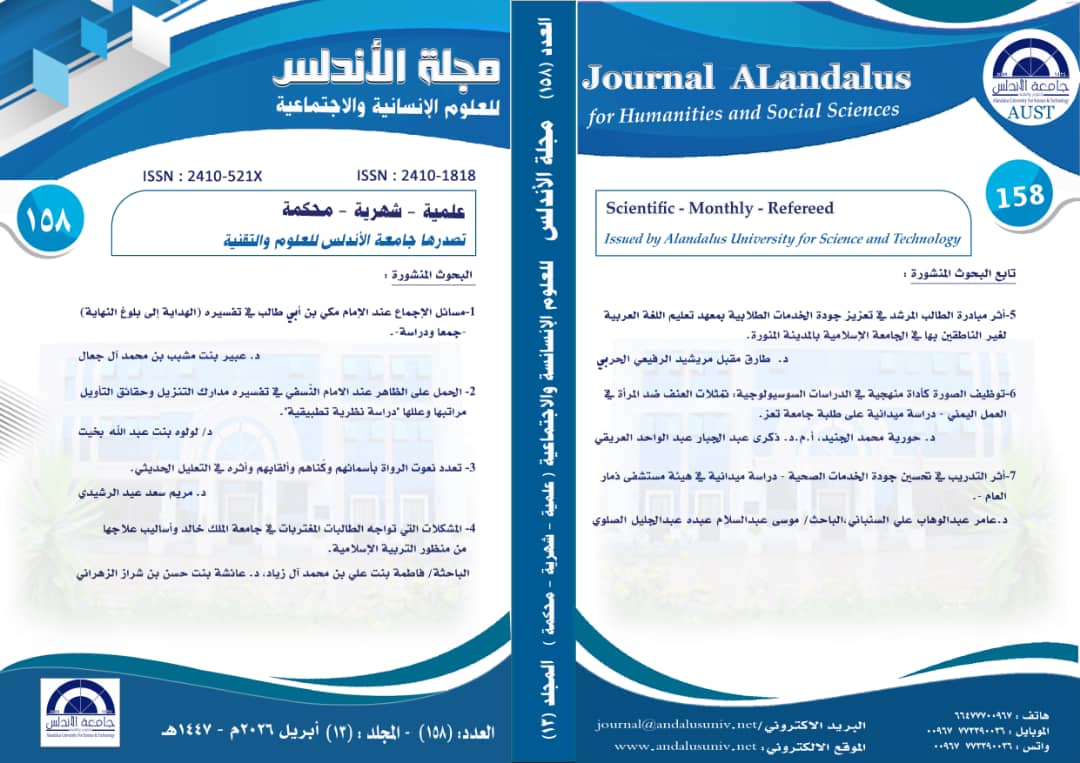
The Impact of Training on Improving the Quality of Health Services: A Field Study at Dhamar General Hospital Authority 10.35781/1637-000-158-007
Article Sidebar
Published:
May 11, 2026
Keywords:
التدريب | جودة الخدمات الصحية | هيئة مستشفى ذمار العام | Training | Quality of Health Services | Dhamar General Hospital Authority
Main Article Content
Abstract
Abstract
This study aimed to identify the impact of training—across its four dimensions (Identifying Training Needs, Program Design, Program Implementation, and Training Evaluation)—on improving the quality of health services at Dhamar General Hospital Authority, while also assessing employees' awareness and examining differences based on demographic variables. Utilizing a descriptive-analytical approach, the study targeted a population of 281 nurses and administrators, from which a stratified random sample of 163 individuals was selected. Data were collected via a questionnaire and analyzed using SPSS. The results revealed that both training and health service quality are practiced at a high level, with mean scores of 3.69 and 3.85, respectively. "Identifying Training Needs" ranked first in practice, while "Training Evaluation" ranked last. Furthermore, the study found a statistically significant impact of training on service quality, with multiple regression indicating that the direct impact is most concentrated in Program Design and Training Evaluation. Analysis of Variance (ANOVA) showed no statistically significant differences in perceptions based on personal variables (age, qualification, experience), suggesting a unified institutional vision. The study recommends transitioning toward scientific methods like Job Analysis for identifying needs and adopting international models, such as the Kirkpatrick Model, to ensure the transfer of training impact to professional behavior and patient safety. Keywords: Training, Quality of Health Services, Dhamar General Hospital Authority.
This study aimed to identify the impact of training—across its four dimensions (Identifying Training Needs, Program Design, Program Implementation, and Training Evaluation)—on improving the quality of health services at Dhamar General Hospital Authority, while also assessing employees' awareness and examining differences based on demographic variables. Utilizing a descriptive-analytical approach, the study targeted a population of 281 nurses and administrators, from which a stratified random sample of 163 individuals was selected. Data were collected via a questionnaire and analyzed using SPSS. The results revealed that both training and health service quality are practiced at a high level, with mean scores of 3.69 and 3.85, respectively. "Identifying Training Needs" ranked first in practice, while "Training Evaluation" ranked last. Furthermore, the study found a statistically significant impact of training on service quality, with multiple regression indicating that the direct impact is most concentrated in Program Design and Training Evaluation. Analysis of Variance (ANOVA) showed no statistically significant differences in perceptions based on personal variables (age, qualification, experience), suggesting a unified institutional vision. The study recommends transitioning toward scientific methods like Job Analysis for identifying needs and adopting international models, such as the Kirkpatrick Model, to ensure the transfer of training impact to professional behavior and patient safety. Keywords: Training, Quality of Health Services, Dhamar General Hospital Authority.
Article Details
Section
المقالات