
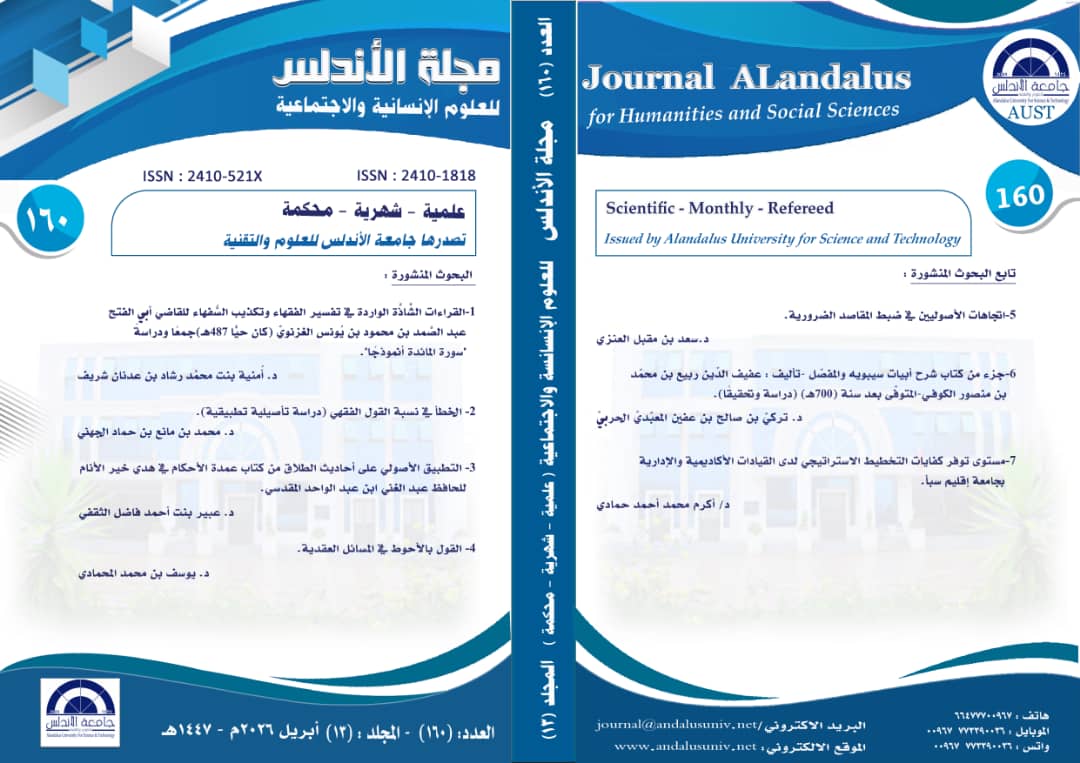
Anomalous Readings in "Tafsir Al-Fuqaha' Wa Takdhib Al-Sufaha'" by Judge Abu Al-Fath Abd Al-Samad Ibn Mahmoud Ibn Yunus Al-Ghaznawi "Alive In 487 AH.": Collection and Study: Surah Al-Ma'idah as a Model 10.35781/1637-000-160-001
Article Sidebar
Published:
May 11, 2026
Keywords:
القراءات | الشاذة | الغزنوي | تفسير الفقهاء | سورة المائدة | Readings | Anomalous | Alghaznawi | Tafsir Al-Fuqaha | Surah Alma'idah
Main Article Content
Abstract
Abstract The study aims to collect and analyze the anomalous readings in Surah Al-Ma'idah through "Tafsir Al-Fuqaha' wa Takdhib Al-Sufaha'" by Imam Abu Al-Fath Abd Al-Samad ibn Mahmoud ibn Yunus Al-Ghaznawi (alive in 487 AH). It focuses on studying and directing these readings by attributing the readings to those who read them, presenting Imam Al-Ghaznawi's views, comparing them with other scholars' opinions, and explaining their impact on the meanings of the verses. The research follows an inductive-analytical method. I began the study with an introduction that included the significance of the topic and the reasons for choosing it, its objectives, the research problem and its questions, the structure of the study, the research methodology and its procedures, as well as the previous studies. I then followed the introduction with two sections: • The first section: A biographical and bibliographical study of the author and his book, consisting of two subsections. • The second section: The anomalous Qur’anic readings mentioned in Tafsīr al Fuquhā’ wa Takdhīb al Sufahā’ in Sūrat al Mā’idah, consisting of nine subsections. Finally, I concluded the study by presenting the most significant findings and recommendations reached. Key Findings: 1. The importance of the book "Tafsir Al-Fuqaha'" and its scientific value, as it encompasses Quranic exegesis, Quranic sciences, Arabic and Sharia sciences, mutawatir and anomalous readings, and the science of readings, highlighting the strong interconnection between these fields and facilitating the recall of their issues. 2. Anomalous readings in Tafsīr al Fuquhā’ are distinguished by various benefits and connotations that enrich the meanings of the verses, including linguistic, grammatical, morphological, rhetorical, and jurisprudential aspects. 3. Anomalous readings provide an expanded and diverse meaning, support and strengthen the meaning of the mutawatir reading, explain its generality, restrict its absoluteness, or prefer one meaning over another. Among the recommendations are the following: 1. Tafsīr al Fuquhā’ is a valuable treasure and a firmly rooted scholarly legacy; it requires further extraction, study, and service, including the completion of collecting and examining the anomalous Qur’anic readings it contains. 2. Continuing along this approach in tracing and studying anomalous readings and the remaining branches of Qur’anic reading sciences, and extracting them from the depths of classical works.
Article Details
Section
المقالات