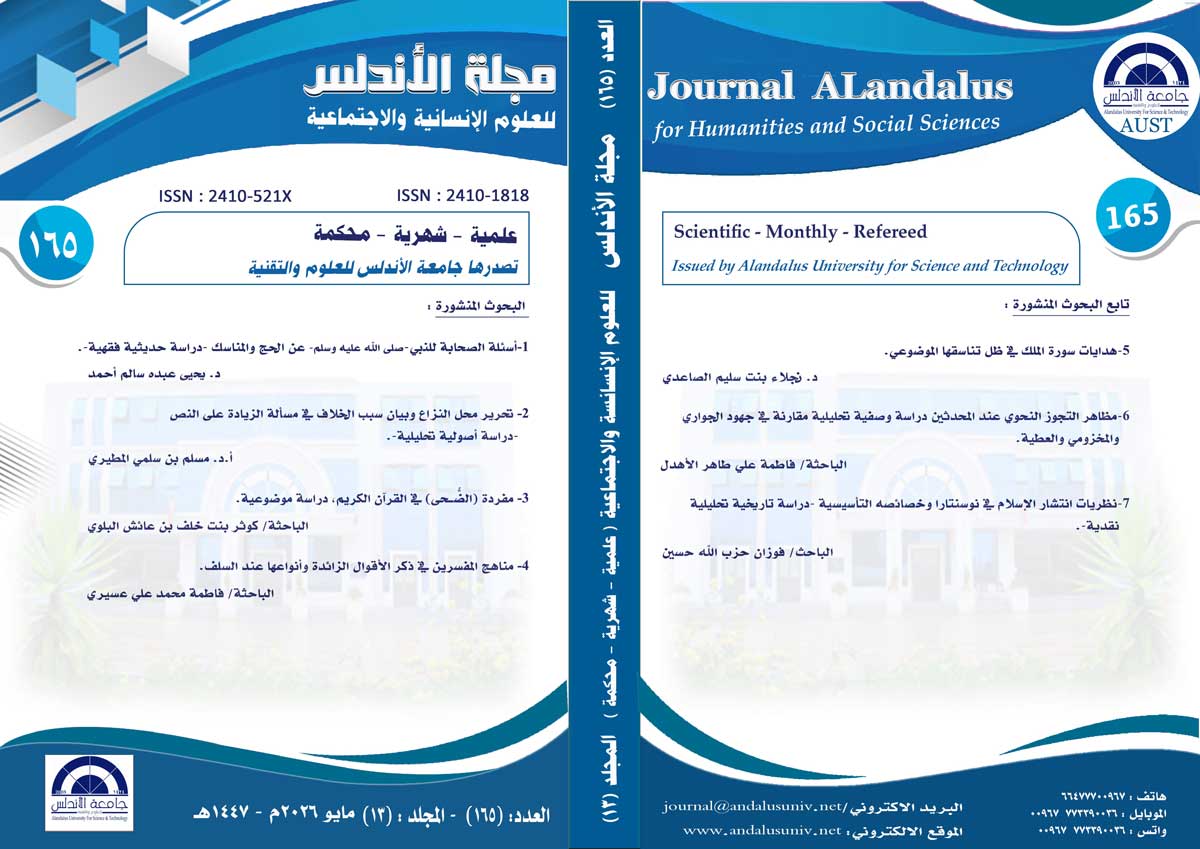
The Guidance of Surah Al-Mulk in the Light of Its Thematic Unity د. نجلاء بنت سليم الصاعدي*
Article Sidebar
Main Article Content
Abstract
This research is titled: "Guidance of Surat Al-Mulk in Light of Its Objective Harmony." The main theme of the Surah focuses on proving the perfection of Allah's absolute dominion and His ultimate power over creation, resurrection, and recompense, while calling for reflection on the manifestations of divine power apparent in the universe and mankind. The Surah, from its beginning to its end, emphasizes and reinforces this purpose. This study aims to highlight the guidance and lessons derived from Surat Al-Mulk through the study of its objective harmony. The methodology adopted combines the analytical approach—to track the verses of the Surah, extract the meanings of its vocabulary, and deduce its most prominent scholarly and practical guidance—and the thematic approach to highlight the Surah’s structural unity. The research is divided into an introduction, four sections, and a conclusion. The first section introduces Surat Al-Mulk by presenting its seven introductory aspects and clarifying its main theme. The second section examines the meanings of the Surah's vocabulary and terms. The third section addresses the scholarly and practical guidance derived from the Surah. Meanwhile, the fourth section is dedicated to studying the objective harmony and characteristics of the Surah's verses. Finally, the conclusion highlights the most prominent findings of the research: that the core theme of Surat Al-Mulk is the affirmation of the perfection of Allah's absolute dominion and His ultimate power over creation, resurrection, and recompense. The objective harmony within the Surah is demonstrated through the precise interrelation between its opening and conclusion. Furthermore, the study reveals that the Surah bridges scholarly guidance with practical, educational lessons, emphasizing the virtue of Surat Al-Mulk and its profound impact on a Muslim's life. Keywords: Surat Al-Mulk, Guidance, Harmony, Core Theme, Characteristics, Virtue.