
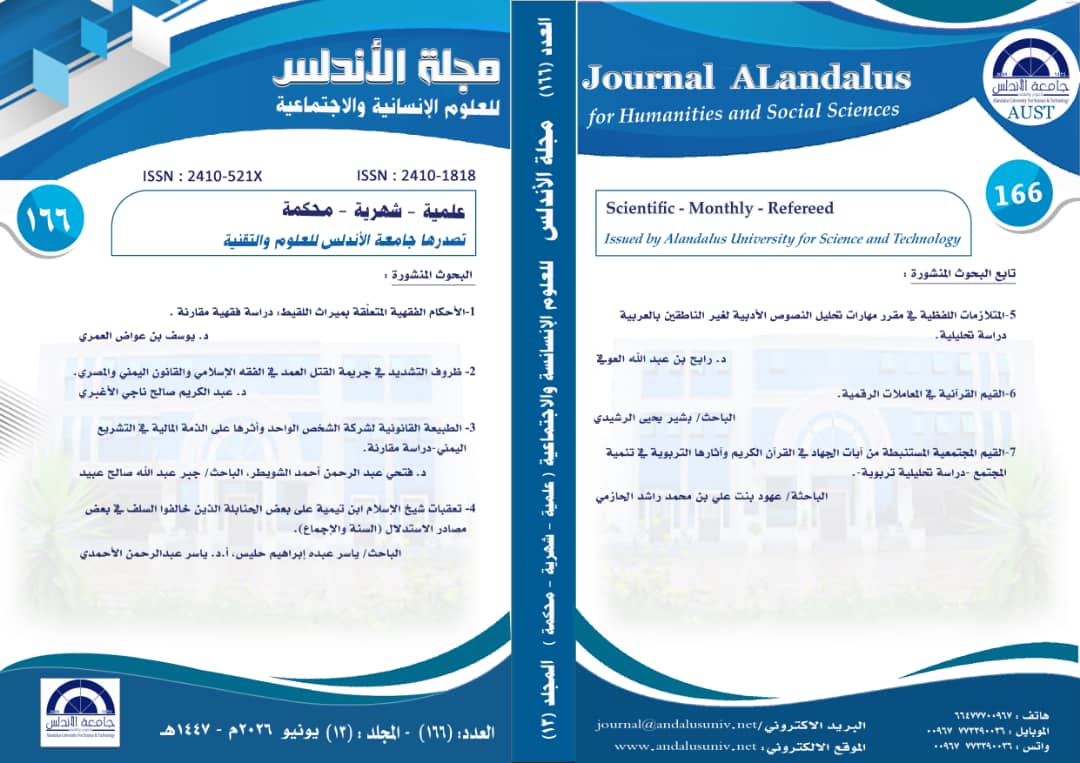
Quranic Values in Digital Transactions 10.35781/1637-000-166-007
Article Sidebar
Main Article Content
Abstract
The world is witnessing an accelerating digital transformation that has reshaped the structure of financial and commercial transactions, transferring them into an electronic environment characterized predominantly by technical complexity and information asymmetry. This has given rise to imbalances relating to contractual ambiguity, informational fraud, hidden fees, data exploitation, and the disruption of balance between contracting parties. In light of this, the need emerges for a normative framework prior to technology itself, one that guides its design and governs its practices; this is precisely what the Qur’anic value system provides.
This study aims to analyze the Qur’anic values governing transactions and to apply them to digital reality as a practical evaluative standard that realizes the objectives of Islamic law (maqāṣid al-sharīʿa) in preserving wealth, safeguarding rights, and preventing injustice. It adopts a deductive-analytical methodology with a maqāṣid-oriented dimension, based on the analysis of Qur’anic texts and the derivation of their implications, which are then brought to bear on the evaluation of contemporary digital models.
The study concludes that Qur’anic values constitute a normative framework capable of regulating and directing digital transformation, and that the integrity of a digital transaction is measured by the realization of justice and transparency, the prevention of excessive uncertainty (Gharar) and deception (Tadlis) and the preservation of the priority of interests when they conflict. The study recommends translating these values into binding governance and disclosure standards within digital platforms, ensuring the clear disclosure of price, risks, and restrictions before contracting, prohibiting hidden fees and deceptive design practices, and strengthening data protection and contractual accountability.
Keywords: Qur’anic values, digital transactions.