
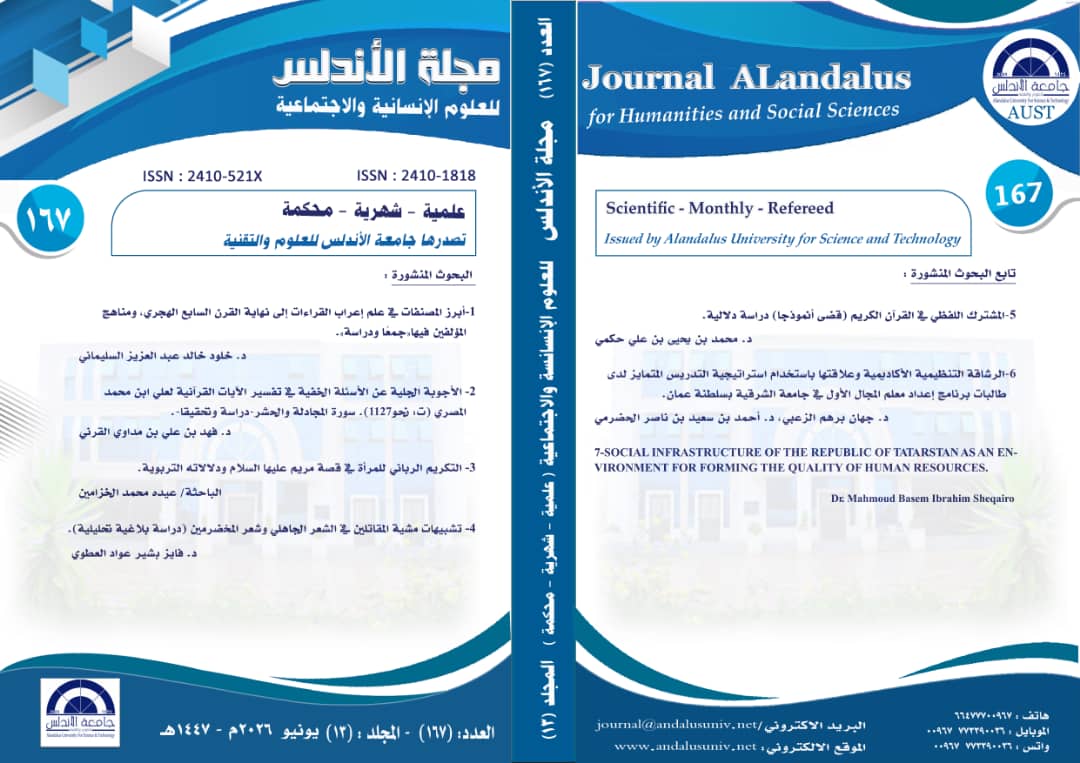
Al'ajwibat Aljaliat Ean Al'asyilat Alkhafiat Fi Tafsir Alayat Alquraniat by Ali Ibn Muhammad Al-Misri "D. C. 1127 AH.": Surah Al-Mujadilah and Al-Hashr: Study and Investigation 10.35781/1637-000-167-002
Article Sidebar
Published:
Aug 27, 2026
Keywords:
سئل | المجادلة | الحشر | الأسئلة | الجلية | Asked | Al-Mujadilah | Al-Hashr | Questions | Clear
Main Article Content
Abstract
Abstract
Abstract This is a research titled: "The Most Prominent Works in the Science of Parsing Quranic Readings up to the End of the Seventh Hijri Century, and the Authors' Methodologies in Them." It aims to collect, specify, and study the most prominent works in the science of parsing Quranic readings from the beginning of the writing era to the end of the seventh Hijri century, and the authors' methodologies in them. The importance of the research lies in its connection to the Book of Allah, the Almighty, which falsehood cannot approach from before it or behind it. It highlights the scholars' attention to the parsing of the Quran, its readings, and the diversity of their writings in it. The importance of parsing the readings for researchers and scholars in Quranic sciences is emphasized, as they cannot do without this knowledge, drawing from its resources, and the desire to study the works that focused on parsing the readings up to the seventh Hijri century, making them accessible to researchers and introducing them to their methodologies. In my research methodology, I followed a descriptive research approach. I collected books related to the parsing of the Quran and its readings in general, then selected books specifically related to the parsing of readings, identifying them from the beginning of authorship to the end of the seventh Hijri century. I then studied the books, providing a clear picture of each book's methodology. I also considered chronological order in arranging the works and mostly sufficed with mentioning the introduction of their authors, with commentary on that, and noted the author's methodology in the readings and their parsing, providing examples and models for that. I structured my work in this research into an introduction, two main sections, a conclusion, and indexes. In the first section, I referred to the definition of Quranic parsing and readings, the stages the parsing of the Quran went through, the rules that the parser of the Quran and its readings must observe, and the relationship between readings and parsing. I dedicated the second section to studying the most prominent works in the science of parsing readings up to the end of the seventh Hijri century and the authors' methodologies in them. I concluded the research with findings, including: • The great care the Holy Quran has received since its revelation to the Messenger of Allah (peace be upon him) until it reached us, evident in the dedication of sincere scholars who preserved it in their hearts and were keen on writing in its various sciences. • The most important thing for the parser of the Quran and its readings is to understand the meaning of what they want to parse, to observe what the craft requires, and to be knowledgeable in the Arabic language and its sciences. • The difference in authorship in parsing readings between works dedicated to parsing the Mutawatir (widely transmitted) readings and others for parsing the irregular readings. • The need for students of Quranic readings to know the authors' methodologies in the books of parsing readings throughout the ages. Recommendations include: • Focusing on studying topics related to the parsing of Quranic readings. • Collecting and studying works on parsing readings after the seventh Hijri century. Keywords: Science of Quranic Parsing – Readings – Works – Grammar – Parser.
Article Details
Issue
Section
المقالات