
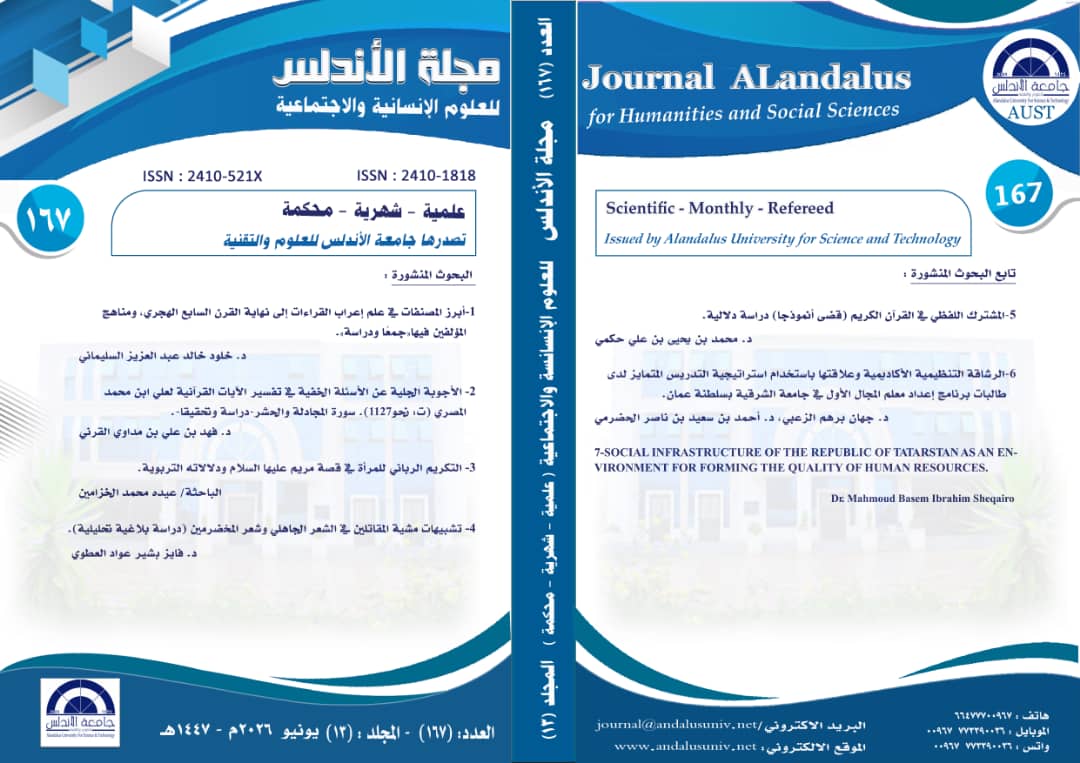
Similes of Warriors’ Gait in Pre-Islamic and Mukhadram Poetry: A Rhetorical and Analytical Study 10.35781/1637-000-167-004
Article Sidebar
Published:
Aug 27, 2026
Keywords:
مشية المقاتلين | الشعر الجاهلي | شعر المخضرمين | التشبيه | التصوير الحركي | الصورة الحربية | Combatants' Gait | Preislamic Poetry | Mukhadram Poetry | Simile | Kinetic Imagery | Martial Imagery
Main Article Content
Abstract
Abstract This study examines the similes of combatants' gaits in Pre-Islamic (Jahili) and Mukhadram poetry, framing them as a nuanced manifestation of kinetic imagery in ancient Arabic poetry. The research proceeds from the premise that a fighter’s gait was not merely a transient physical posture, but rather carried profound connotations of steadfastness, composure, and psychological readiness to face death. Employing an inductive-analytical approach, the study surveys poetic evidence depicting the movement of warriors heading into battle. These excerpts are subsequently classified according to the vehicle of the simile (Mushabbah bihi), allowing for a critical examination of their artistic, psychological, and social implications. The findings reveal that poets did not invoke imagery of camels, lions, torrential floods, thunder, and glowing embers as mere rhetorical embellishments. Rather, these elements were deliberately selected for their precise resemblance in physical posture, rhythm, awe-inspiring nature, and the psychological impact of the movement. Furthermore, the study demonstrates the multi-layered significance of camel depictions: formidable camels (al-Masa'ib) suggest resistance and ferocity; fully mature camels (al-Buzl) denote the culmination of strength; heavily burdened camels (al-Dawalih) reflect a ponderous movement under the weight of armor; radiant camels (al-Zuhr) evoke dignity and an elevated stature; while mangy camels treated with pitch (al-Jarab al-Mahnu'a bil-Qatran) symbolize impulsiveness and fierce agitation. Ultimately, the research concludes that the similes of fighters' gaits highlight the ancient poet's profound awareness of kinetic value in constructing martial imagery. It underscores the capacity of the simile to transform a visual scene into a psychological and social symbol that profoundly embodies the ideals of heroism, solidarity, and belonging. Keywords: Combatants' gait, Pre-Islamic poetry, Mukhadram poetry, Simile, Kinetic imagery, Martial imagery.
Article Details
Issue
Section
المقالات