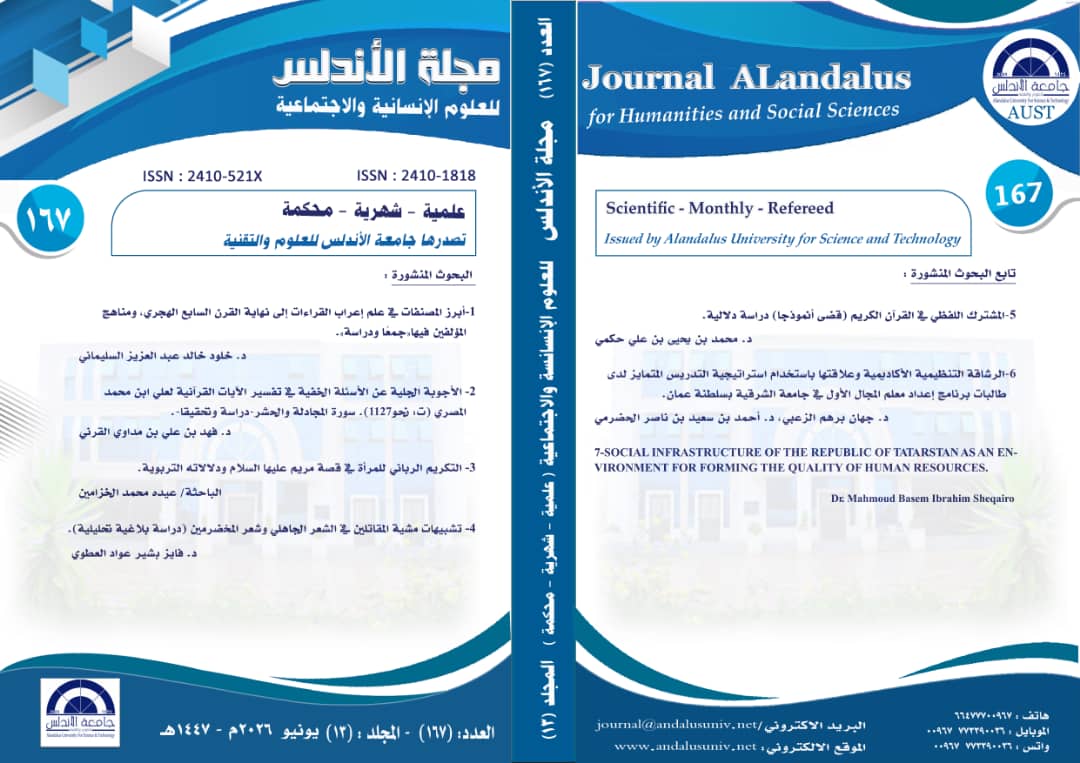
Homonyms in the Holy Quran: The Word "Qada" as a Model: A Semantic Study 10.35781/1637-000-167-005
Article Sidebar
Published:
Aug 27, 2026
Keywords:
المشترك اللفظي | الدلالة | السياق | البنية الصرفية | قضى | Homonymy | Meaning | Context | Morphological Structure | Qada
Main Article Content
Abstract
Abstract It is not hidden from any discerning mind that the Arabic language possesses characteristics and features that are not available – collectively – to other languages. Perhaps one of the most prominent phenomena that distinguishes Arabic is the phenomenon of homonymy, which has a wide presence in the language and its various uses. Hence, this research came to examine this phenomenon in general, and the word (qada) and its uses in the Holy Qur’an in particular. The introduction stopped at the semantic and contextual aspects of the linguistic event, while the first section was limited to explaining the role of context in clarifying the meaning of the word qada in the Holy Qur’an. The second section examines the impact of morphological structure on the meaning of a word. The research employed two methodologies: inductive and descriptive-analytical, as these were deemed most suitable for tracing and identifying the occurrences of this word in the Holy Quran, then analyzing it and demonstrating the influence of context and morphological structure on its specific meaning. The research yielded several findings, most notably- The Arabs were aware of three meanings: intellectual, natural, and contextual. - The meaning of a word in a text is contingent upon what is known as contiguity. - The word (qada) is a prime example of homonymy and the influence of context and morphology on it, due to its frequent occurrence in the Holy Quran. - Context served as a guide in determining the meanings of the word (qada), and this does not refer to the context of the verse or chapter, but rather the context of the entire Holy Book. - Some commentators did not limit themselves to the linguistic context in determining the meaning of (qada); rather, they employed the social, cultural, and emotional context in the interpretation process. Keywords: homonymy, meaning, context, morphological structure, (qada).
Article Details
Issue
Section
المقالات