
Disciplinary Offenses and Sanctions for University Faculty Members under the Yemeni Universities Law: A Comparative Study 10.35781/1637-000-169-007
Article Sidebar
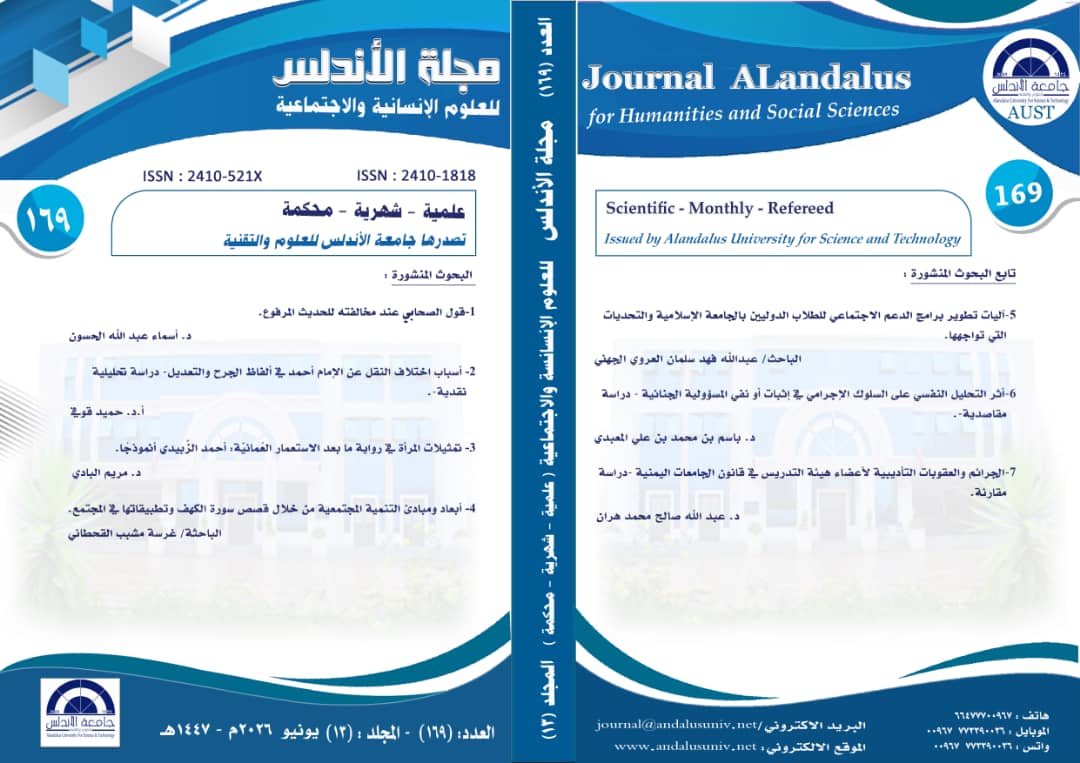
Published:
Oct 14, 2026
Keywords:
الجريمة التأديبية | العقوبة التأديبية | أنواع العقوبات التأديبية | عضو هيئة التدريس بالجامعة | الإخلال بالواجب الوظيفي | Disciplinary Offense | Disciplinary Sanction | Classification of Disciplinary Sanctions | University Faculty Member | Breach of Professional Duty
Main Article Content
Abstract
Abstract
Abstract The Yemeni legislator has enacted specialized legislation governing university faculty members, reflecting the critical role they play in upholding honor, integrity, and the fundamental academic values and societal traditions of the nation as the cornerstone of the educational process. This legal framework delineates the specific duties and prohibitions binding upon faculty members; any breach thereof constitutes a disciplinary offense punishable by sanctions explicitly prescribed by law. This research aims to analyze these professional duties and prohibitions, the breach of which constitutes a disciplinary offense, and to examine the corresponding disciplinary sanctions applicable to faculty members who fail to fulfill their obligations. The study is structured into two primary sections: the first examines the nature of disciplinary offenses, providing a comprehensive definition and classification. The second section focuses on disciplinary sanctions, covering their definitions, classifications, and the fundamental legal principles governing their application. The researcher has adopted the analytical method through the analysis of legal texts, and the comparative method by comparing Yemeni legislation with Egyptian law. The research concludes with significant findings and recommendations. Key findings indicate that the Yemeni legislator has relegated the codification of duties and prohibitions to a decree issued by the Prime Minister rather than embedding them within the primary law. Furthermore, the research observes that the private life of a faculty member is not entirely distinct from their professional standing. The research recommends, most notably, the abolition of the sanction of dismissal accompanied by the forfeiture of pension rights, advocating for the retention of dismissal as a standalone sanction. Furthermore, it strongly advises that all professional duties and disciplinary sanctions be codified within the Universities Law itself, rather than being governed by Prime Ministerial decrees. Keywords: Disciplinary Offense, Disciplinary Sanction, Classification of Disciplinary Sanctions, University Faculty Member, Breach of Professional Duty
Abstract The Yemeni legislator has enacted specialized legislation governing university faculty members, reflecting the critical role they play in upholding honor, integrity, and the fundamental academic values and societal traditions of the nation as the cornerstone of the educational process. This legal framework delineates the specific duties and prohibitions binding upon faculty members; any breach thereof constitutes a disciplinary offense punishable by sanctions explicitly prescribed by law. This research aims to analyze these professional duties and prohibitions, the breach of which constitutes a disciplinary offense, and to examine the corresponding disciplinary sanctions applicable to faculty members who fail to fulfill their obligations. The study is structured into two primary sections: the first examines the nature of disciplinary offenses, providing a comprehensive definition and classification. The second section focuses on disciplinary sanctions, covering their definitions, classifications, and the fundamental legal principles governing their application. The researcher has adopted the analytical method through the analysis of legal texts, and the comparative method by comparing Yemeni legislation with Egyptian law. The research concludes with significant findings and recommendations. Key findings indicate that the Yemeni legislator has relegated the codification of duties and prohibitions to a decree issued by the Prime Minister rather than embedding them within the primary law. Furthermore, the research observes that the private life of a faculty member is not entirely distinct from their professional standing. The research recommends, most notably, the abolition of the sanction of dismissal accompanied by the forfeiture of pension rights, advocating for the retention of dismissal as a standalone sanction. Furthermore, it strongly advises that all professional duties and disciplinary sanctions be codified within the Universities Law itself, rather than being governed by Prime Ministerial decrees. Keywords: Disciplinary Offense, Disciplinary Sanction, Classification of Disciplinary Sanctions, University Faculty Member, Breach of Professional Duty
Article Details
Issue
Section
المقالات