
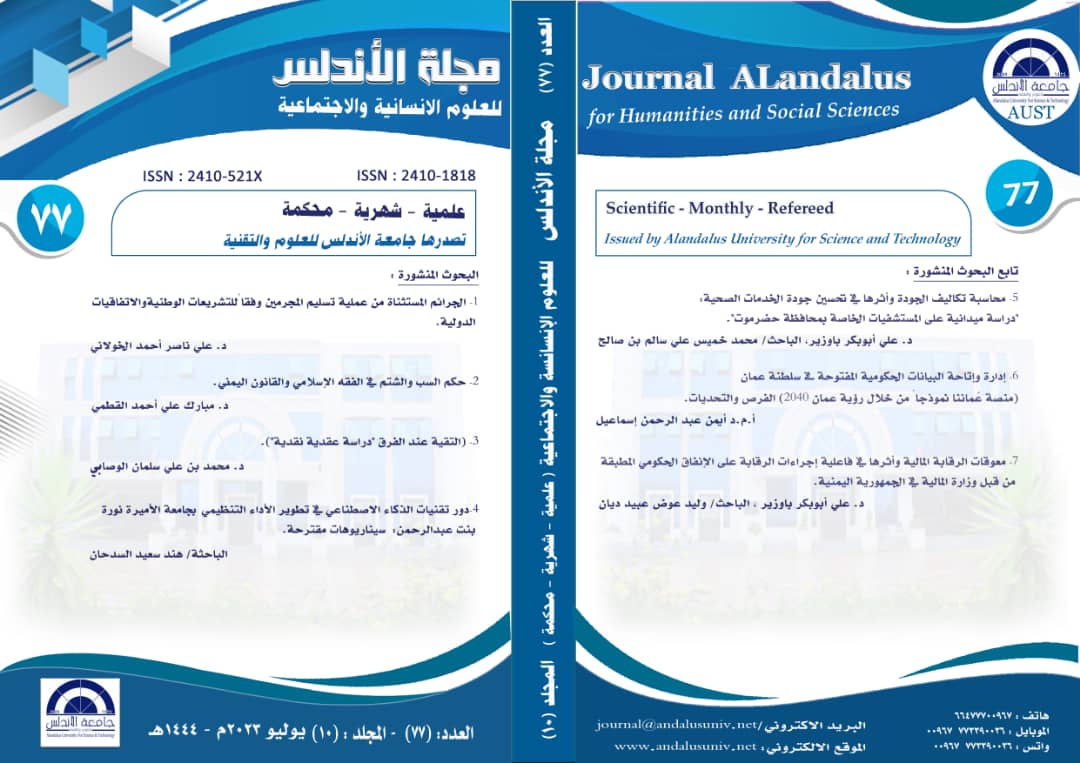
Obstacles to Financial Control and their Impact on the Effectiveness Government Spending Control Procedures Applied by the Ministry of Finance in the Republic of Yemen: A Field Study
Article Sidebar
Main Article Content
Abstract
The study aimed to determine the level of financial control obstacles represented by the dimensions of (technical obstacles, legal obstacles and regulatory obstacles) and to determine their impact on the control procedures on government spending applied by the Ministry of Finance in the Republic of Yemen. The study followed the descriptive analytical approach to achieve the study objectives and test its hypotheses. The study population consisted of (50) auditors and account managers representing all employees in the audit department in the finance offices, in addition to the account managers in the offices of other administrative units in Hadhramaut governorate (the valley and the desert). Given the small size of the study population, the complete census method was adopted to determine the study sample, which reached (45) respondents, whose responses were obtained through the questionnaire tool. Based on the data analysis conducted by the statistical analysis using the Statistical Package for Social Sciences (SPSS), the results revealed that; There is a negative impact of the financial control obstacles in their dimensions (organizational obstacles, legal obstacles and technical obstacles) on the procedures for controlling government spending applied by the Ministry of Finance in the Republic of Yemen, and that the impact of the dimensions of financial control obstacles on government spending control procedures was uneven, where the dimension of organizational obstacles had the highest impact on financial control procedures, followed by legal obstacles, and the dimension of technical obstacles came in last place. The results also showed that the financial control obstacles faced by financial offices in the valley and desert districts in Hadramout governorate were moderate. The study made a number of recommendations, the most important of which are; paying more attention to continuous training and increasing the training courses for auditors in order to provide them with sufficient knowledge of the standards of professional practice and to learn about the latest modern auditing methods and developments, the necessity of issuing sufficient legislation governing financial control procedures, and the study also recommended the importance of benefiting from the experiences of regional and global countries in the field of financial control.