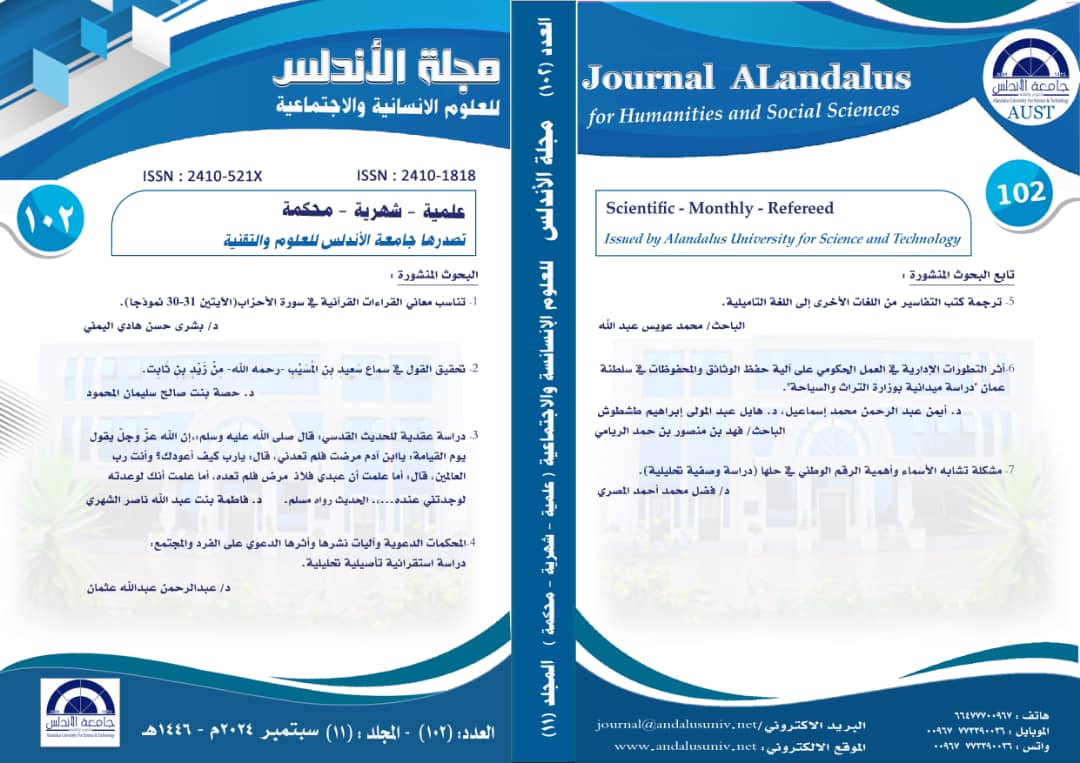
Doctrinal Study in the Sacred Hadith Prophet Mohammed Peace Be Upon Him Said "Allah the Almighty Says Son of Adam I Was Ill and You Did Not Visit Me, He Will Say 'O Lord, How Could I Visit You When You Are the Lord of the Universe? He Will Say Do You Not 10.35781/1637-000-102-003
Article Sidebar
Main Article Content
Abstract
The prophetic tradition is an authentic source of Islamic belief. The Islamic ancestor and their Khalafs have taken well care of it. So I wanted to contribute in what may help spreading the sunnah of the messenger of Allah peace be upon him. The significance of the study is: I explained a sacred Hadith in relation to the perspective of Sunnah, that includes doctrinal issues. For example: 1. Proven the existence and truthfulness of Allah’s Most Beautiful Names and His Highest Attributes in terms of closeness to Allah, presence, subjectivism. 2. The sacred Hadith showed the graciousness and differentiation in terms of superiority of good deeds such as visiting patients, feeding those in need, free water distribution (Sabil). The study curriculum is subjected to two methodologies: First: The extractive approach based on the statement of the origins of Ahlu Sunna Wal Jama 'a belief in God's Names and His Attributes section, and then used it on the meaning of the verse intended for study. Second: The evidentiary inductive approach based on the collection of scientific material from the Holy Quran and Sunnah, and the words of the people of science. The main findings are: sacred Hadith refers to some of the Sunnah assets such as: 1- The priority of considering Sharia over reason and logic. 2- Understanding the actual meaning of Allah’s Highest Attributes. 3- Understanding the difference between similar Quranic verses that have more than one meaning and Quranic verses which have only one specific meaning. 4- Atheism can be proven through some specific Hadiths that have a few narratives and that can be considered as evidence in Sunnah belief. 5- The penalty in the afterlife depends on the actions and deeds. I wish Allah may benefit who writer it, the reader and all Muslims.