
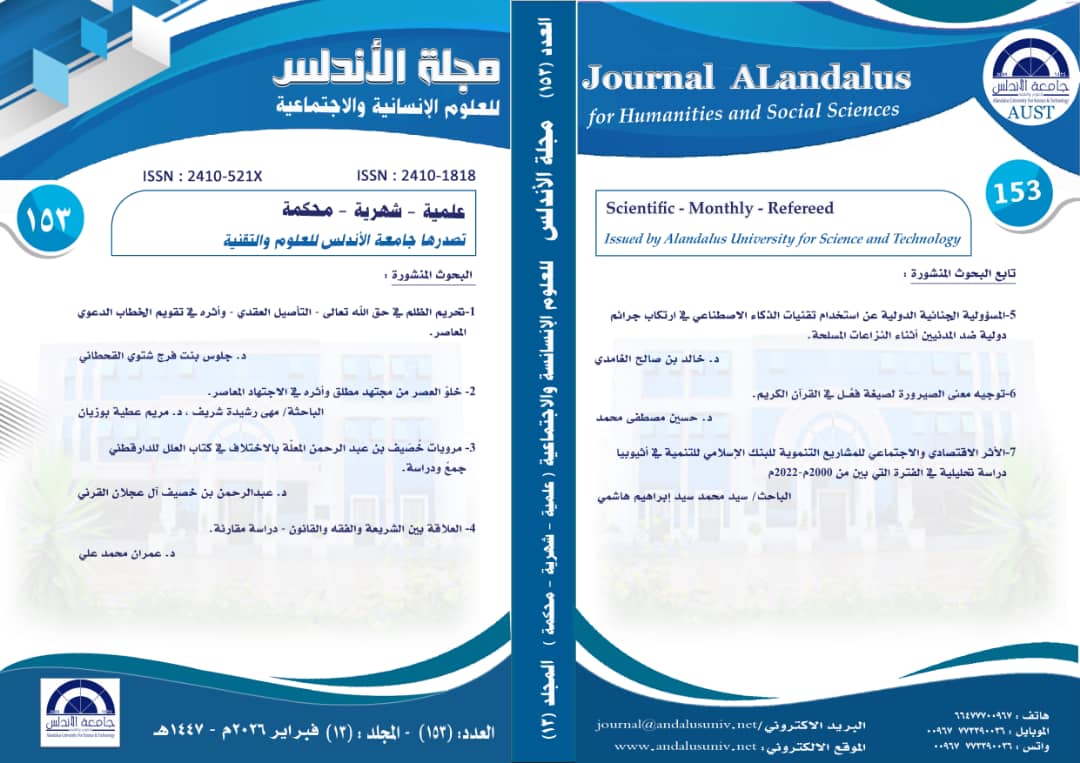
International Criminal Responsibility for the Use of "AI" in the Commission of International Crimes against Civilians during Armed Conflicts 10.35781/1637-000-153-005
Article Sidebar
Published:
Mar 7, 2026
Keywords:
الذكاء الاصطناعي | الروبوت | المسؤولية الجنائية الدولية | الأعمال العسكرية | المدنيين | النزاعات المسلحة | Artificial Intelligence | Robotics | International Criminal Responsibility | Military Actions | Civilians | Armed Conflict
Main Article Content
Abstract
Abstract: This study addresses the issue of international criminal responsibility arising from the use of artificial intelligence technologies in military operations, in light of the rapid transformation in the nature of warfare methods and tactics, and the increasing reliance on military systems capable of operating with varying degrees of autonomy from human intervention. This topic arises within the context of growing legal and humanitarian concerns related to the potential for serious violations of international humanitarian law resulting from the use of artificial intelligence systems, and the consequent difficulties in determining criminal responsibility for such violations. This study aims to examine the extent to which existing rules of international criminal law can be used to establish international criminal responsibility for unlawful acts that may result from the use of artificial intelligence in armed conflicts. This will be achieved through an analysis of the legal frameworks governing international criminal responsibility and by clarifying the limits of their application in cases where direct human involvement in decision-making or execution is diminished. The research also seeks to differentiate between potential forms of responsibility, whether related to the responsibility of the state, military commanders, users, or entities responsible for developing and manufacturing these systems, highlighting the legal basis for each. This study addresses several questions surrounding international criminal responsibility for these acts and whether traditional concepts of international criminal responsibility can be applied to this unprecedented type of behavior. This is particularly relevant given the unique nature of artificial intelligence (AI). Furthermore, the use of AI in the military raises issues concerning the application of fundamental principles of international humanitarian law, most notably the principle of distinction between combatants and civilians, the principle of proportionality, and the principle of military necessity. The extent to which AI systems can adhere to these principles remains a subject of extensive legal and scholarly debate, especially considering the potential for technical errors, software malfunctions, misuse, or the absence of effective human oversight during military operations. This study uses an inductive-analytical approach, reviewing and building upon previous studies and analysing international legal texts related to armed conflict to determine the consistency between the use of military artificial intelligence applications and relevant legal provisions. Keywords: Artificial intelligence, robotics, international criminal responsibility, military actions, civilians, armed conflict.
Article Details
Section
المقالات