
Usuli Distinctions According to Abu al-Husain al-Basri in the Chapter on the Sunnah https://doi.org/10.35781/1637-000-155-003
Article Sidebar
Published:
Apr 30, 2026
Keywords:
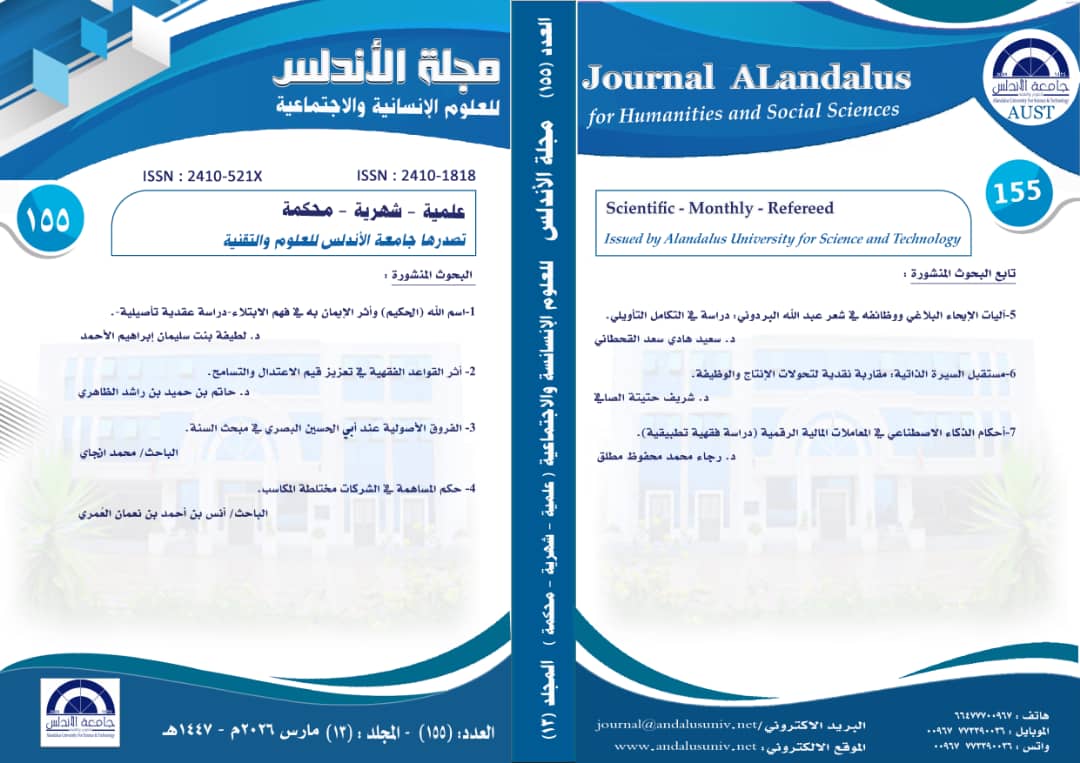
الفروق الأصولية عند أبي الحسين البصري في مبحث السنة
Main Article Content
Abstract
Abstract
Abstract Research Objective: The research aims to study the usulī distinctions formulated by Abū al-Ḥusain al-Baṣrī in the chapter on the Sunnah, to highlight their great importance and significant benefits, as well as their role in regulating concepts, principles, issues, and legal rulings. It also seeks to clarify the scholarly status of Abū al-Ḥusain al-Baṣrī and his influence on the development of usul al-fiqh (Principles of Islamic Jurisprudence) writings among later scholars of legal theory. The research is structured into an introduction, a preface, five chapters, a conclusion, and a bibliography of sources and references. The introduction includes the following: the research problem, the significance of the topic, the reasons for choosing it, the objectives of the study, the scope and limitations of the research, previous studies, the research methodology, and the research plan. As for the preface, it includes: a definition of usulī distinctions and an introduction of Abū al-Ḥusain al-Baṣrī. The first chapter examines the distinction between mutawātir and āḥād reports; the second chapter discusses the distinction between solitary reports (khabar al-wāḥid) and testimony; the third chapter addresses the distinction between the transmission of reports whose recitation is considered an act of worship and those whose recitation is not, when transmitted by meaning; the fourth chapter explores the distinction between a narrator’s statement “ḥaddathanī” (“he narrated to me”) and “akhbaranī” (“he informed me”); and the fifth chapter deals with the distinction between mursal reports and testimony based on testimony. Among the most important findings reached by the study are the following: 1. The distinction between narration (riwāyah) and testimony (shahādah) is one of the most well-known usulī distinctions related to the Sunnah. The concern of usul scholars with distinguishing between the two can be traced back to early times, beginning with Imam al-Shāfiʿī (may Allah have mercy on him) in al-Risālah. 2. The term “akhbaranī” has a broader semantic scope than “ḥaddathanī”. Keywords: Usulī distinctions – Abū al-Ḥusain al-Baṣrī.
Abstract Research Objective: The research aims to study the usulī distinctions formulated by Abū al-Ḥusain al-Baṣrī in the chapter on the Sunnah, to highlight their great importance and significant benefits, as well as their role in regulating concepts, principles, issues, and legal rulings. It also seeks to clarify the scholarly status of Abū al-Ḥusain al-Baṣrī and his influence on the development of usul al-fiqh (Principles of Islamic Jurisprudence) writings among later scholars of legal theory. The research is structured into an introduction, a preface, five chapters, a conclusion, and a bibliography of sources and references. The introduction includes the following: the research problem, the significance of the topic, the reasons for choosing it, the objectives of the study, the scope and limitations of the research, previous studies, the research methodology, and the research plan. As for the preface, it includes: a definition of usulī distinctions and an introduction of Abū al-Ḥusain al-Baṣrī. The first chapter examines the distinction between mutawātir and āḥād reports; the second chapter discusses the distinction between solitary reports (khabar al-wāḥid) and testimony; the third chapter addresses the distinction between the transmission of reports whose recitation is considered an act of worship and those whose recitation is not, when transmitted by meaning; the fourth chapter explores the distinction between a narrator’s statement “ḥaddathanī” (“he narrated to me”) and “akhbaranī” (“he informed me”); and the fifth chapter deals with the distinction between mursal reports and testimony based on testimony. Among the most important findings reached by the study are the following: 1. The distinction between narration (riwāyah) and testimony (shahādah) is one of the most well-known usulī distinctions related to the Sunnah. The concern of usul scholars with distinguishing between the two can be traced back to early times, beginning with Imam al-Shāfiʿī (may Allah have mercy on him) in al-Risālah. 2. The term “akhbaranī” has a broader semantic scope than “ḥaddathanī”. Keywords: Usulī distinctions – Abū al-Ḥusain al-Baṣrī.
Article Details
Issue
Section
المقالات